Keep Chewing
June 5, 2026
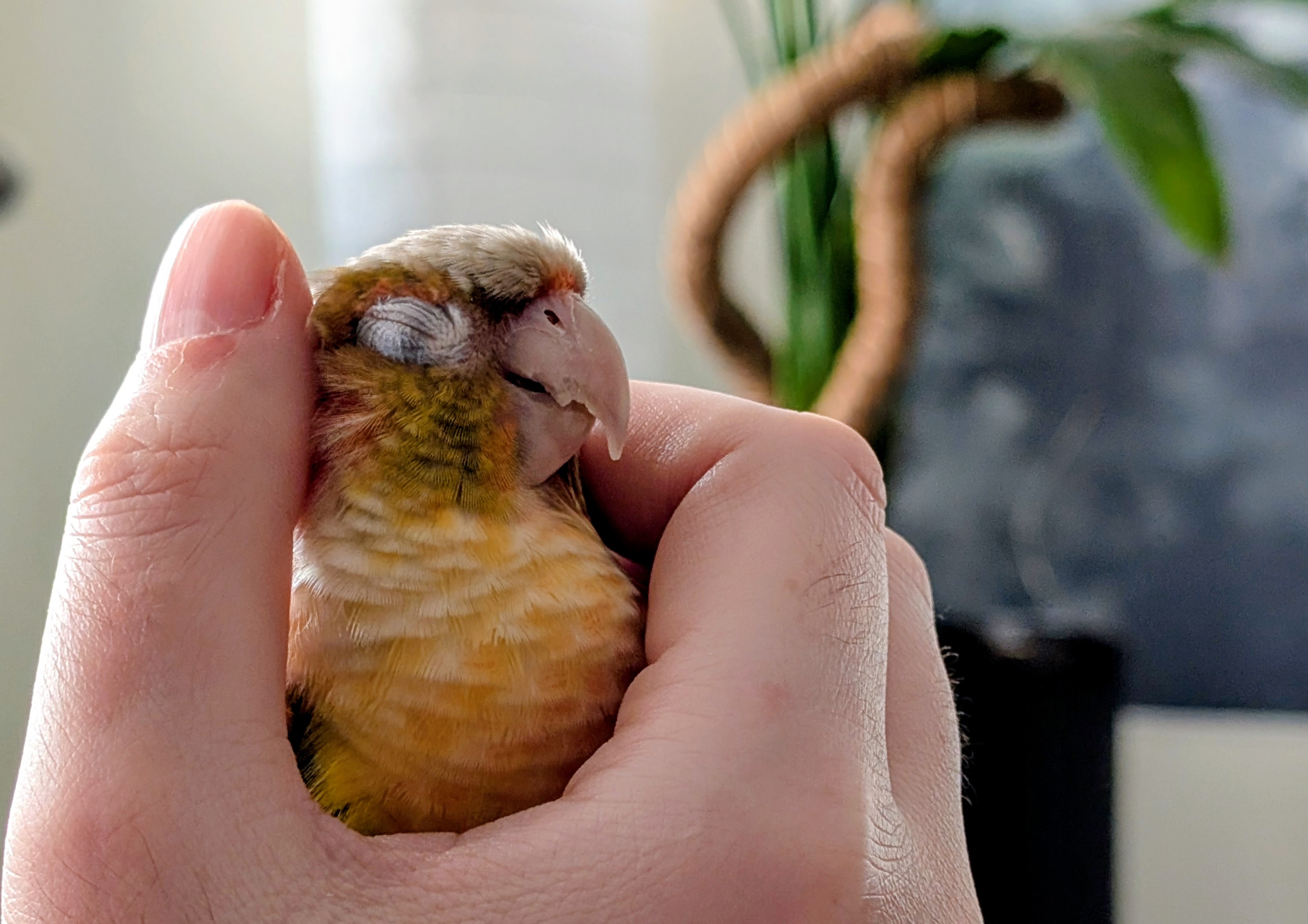
I am friends with a green-cheeked parakeet. I call her my Little One because she is small and because she doesn't like sharp consonants. She is a rescue, about five years old when I came to know her, and I know little of her history before that. She is anxious, mischievous, and fiercely territorial about spaces she identifies as hers.
She loves to be cuddled in my hand. She also loves to bite my hand, but if I can physically tolerate her initial excitements she will generally taper off into gentle nibbles before falling asleep right there in my palm.
Parakeets, like all other parrots that I know of, love to chew. One of the basic necessities of keeping a bird is to provide them with a steady supply of interesting toys for them to chew into progressively smaller and more ruined pieces.
My Little One has been giving her attentions to one such toy, a hanging variety, for the last several days. It consists of a length of differently-shaped pieces of wood and cardboard, in all sorts of bright and appealing colors accomplished with safe-to-eat dyes, strung together with a cord of natural fibers.
The length of time one of these toys remains serviceable varies from bird to bird, but the general idea is to entice the bird to tackle it one plank at a time, wrenching each in their turn free from the cord, admiring the accomplishment for a minute or two, and discarding the piece before attacking the next one.
My Little One set her sights on loftier ambitions this week. She has ignored the wood and the cardboard altogether, instead focusing her attentions on the cord, specifically the knot holding it to the metal link by which the whole affair is suspended from the roof of her cage. Each day this week I have watched her gnaw determinedly at that knot, taking it in shifts, pacing herself.
This week while Little One has chewed away I have been dabbling in game programming, specifically in Lua. I have learned code in fits and starts several times over the years, most consistently in high school. Usually I put it down long enough to forget most of what I learned, but I think some of the fundamentals have stuck.
I was feeling a little bit discouraged this afternoon because I have hit a wall with certain questions like how to organize your functions across different files, but more deeply I have been grappling with a lack of the necessary fundamentals in math to fully grasp ideas like collision detection and level tables. As a result I've taken one step back and popped open a math textbook, but now I'm finding that I'm having some challenges there and may need to take another step back to address yet another substrate of knowledge.
As I was stewing in this miniature, self-induced creative crisis, I heard a little crash from across the room. The hanging toy that my Little One has been chewing away at so diligently all week finally came apart at the knot and landed on the floor of the cage. My Little One stood looking at me on the adjecent perch, beaming with triumph.
Birds are very intelligent. Most animals are more intelligent than we recognize or give them credit for, but birds are a well-known example. They can solve puzzles, use tools, hide things, carry grudges, experience grief and affection.
Something birds do not seem to exhibit as often or as readily as humans do is discouragement. They do not get dismayed in any visible way by a lack of immediate results. If they spy a good meal that they can't immediately get at they case the joint, test the defenses, apply mathematics, and get the treat. If a strong gale knocks down their nest they start gathering more sticks. They press doggedly onward, for however long it takes, until they get shit done.
Most of us have things we want to accomplish, both individually and collectively, that aren't done in the space of an hour or an afternoon. Maybe it's cultivating a new hobby, craft, or skill. Maybe it's organizing your community. Maybe it's undoing the causes and damages of climate change. Maybe it's transing your gender.
It's easy for us humans to be discouraged in these longform pursuits for a variety of overlapping reasons. Adult life is rife with cares, worries, problems, barriers, enticements, and distractions which compete for our attention. Many of us are taught from a young age that pursuits which do not in some way make us money are wasteful and therefore we feel guilty about nurturing them. Our algorithmic lives further teach us to expect instantaneous gratification for our wants, with no regard to the depth of the want or the shallowness of the gratification. For a few centuries we have been giving one third of our day to bosses, another third to landlords, and now the worst people on the planet ("Mark Zuckerberg", "Elon Musk", etc.) are fighting over the last third.
All very discouraging.
All of these things are factors, but I think there's something additional and deeper. Our desires are often in some way reactive to dissatisfaction ("I am not happy with the mismatch between how my body inwardly feels and is outwardly read"; "I am not happy with a status quo of unchecked harms upon our planet and the living beings that live upon it, which include ourselves"), and beginning the work of responding to that dissatisfaction does not immediately remove the inciting cause of that dissatisfaction.
That dissonance between dissatisfaction and desire can be, depending on the size of the dissatisfaction and the desire, respectively, varying magnitudes of agonizing.
The worst part of it, however, is that we are taught to accept this agony not as a sign that growth and change are happening, that muscles long out of practice are being called to action, but as a rebuke of our efforts, as summary proof that we were foolish to try, that we should only ever attempt the easy, that everything else is too large and out of our hands.
How very wrong all of that is.
One of the many things I am not is a parakeet psychologist; I can't tell you the inner mechanisms of my Little One's mind. But I can tell you with a high degree of confidence that her desires are not stymied by decades of exposure to Instagram reels of more photogenic and impressive-looking birds who can cleave a hanging cord in twain in a single stroke with their shapely and well-maintained beaks. She is not troubled by one, two, three days of steady nibbling without the assurance of immediate results. She trusts in the nobility of her own craft on a level that we as human beings most often have had beaten out of us by the time we reach adulthood.
Our progress in accomplishing our hearts' truest wants is rarely linear or immediate. We don't see the progress in real time, even as the progress is happening; it is only in retrospect that we can survey where we were in relation to where we are. It's like that with learning code. It's like that with changing your fashion and getting on hormones. And yeah, it's like that with curbing emissions, transitioning to renewables, and rewilding.
The point here is that living with my Little One is a lesson in humility. For all my opposable thumbs and scrollable feeds and worldly learnings and frustrations, she knows something at the autonomic level that I have to work to recollect.
That recollection is worthwhile. It's part of the work.