White Protagonism, Early Shmups, and Galaxian
August 17, 2025
 It's a bit of a commonplace to describe video games as power fantasies--as a form of interactive entertainment, they are well-positioned to transport players into scenarios that allow them to feel powerful--even and perhaps especially when they do not feel powerful in their own material lives. This is not the way of absolutely every video game--compelling counter-examples are plentiful, and arguably easier to discover and access than they have ever been as indies have proliferated in genre, number, platform, and creative mode. But when we trace games back to their historical roots as an outgrowth of both western military computing developments and global capitalistic ambitions (Dyer-Witheford & de Peuter, 2009), it's easy to appreciate that the mainstream commercial video game is structurally inclined to interpellate (Althusser, 1971) a player subject along a set of values that align with those of Empire (Hardt & Negri, 2000).
Okay--the claim that games cultivate a specifically western imperial subjectivity is a bit of a different observation than the one I led with, that video games are by and large power fantasies, but they are close cousins. Meghna Jayanth (2021) specifically connects the broad structural conceits of video games to white supremacy, in a partnership she calls white protagonism:
"The video game world lends itself to fantasies of neoliberal individualism, and the white protagonist allows us to play out these false pleasures. The white protagonist is, in this way, easily harnessed by the ideologies of capitalism-colonialism. The white protagonist -- and video games which conform to these logics -- help hide from the player their own fundamental powerlessness, in the game -- and I would argue -- in the world also, providing the illusion of agency and self-expression which makes it easier to bear the actual lack of those same needs."
The tendrils of white protagonism burrow into the bedrock of commercial games and strangle the soil. It's not merely about whether the player character is white (though that can be a part of it). It's the sword in the stone that empowers you and you alone to deliver the kingdom from the tyranny of the dark-skinned usurper. It's the way in which military shooters give western countries their proper names and make new ones up for the places your squad invades. It's the many, many attempts, on a sliding scale of clumsiness, to tell a story about racism with elves and dwarves, or aliens and robots. It's Princess Peach's castle standing tall in the sunny meadows of World 1 while sand dunes and sitars dress the set of World 2.
Jayanth sees games as vectors of empire in more than just their narrative structure, but also in the way they seek to dominate our leisure time to the exclusion of all other pursuits, and especially their own industry competitors. She could be describing any live service game when she remarks, "In game design we can see this as a tendency towards attention-seeking design -- design which seeks to colonise the player's time and attention, to be demanding within 'attention-economy'".
Shmups (or shoot-em-ups, or scrolling shooters, or STGs--shooting games--if you like) are not the hegemonic mode of commercial game development and publishing in any way that resembles their popularity in the 80s and 90s--indeed, they are somewhat juxtaposed against the contemporary output of major commercial publishers by virtue of their economy of style. The kind of worldbuilding that inflicts the words "mechanical apartheid" on the player's psyche, for instance, is usually a little out of scope for a game that consists of eight stages and takes forty minutes to complete.
This brevity in both design and play, however, does not quarantine shmups from the industry's broader interpellative projects. On the contrary, I think shmups are very concise distillations of both power fantasy and white protagonism, going back to some of their earliest examples.
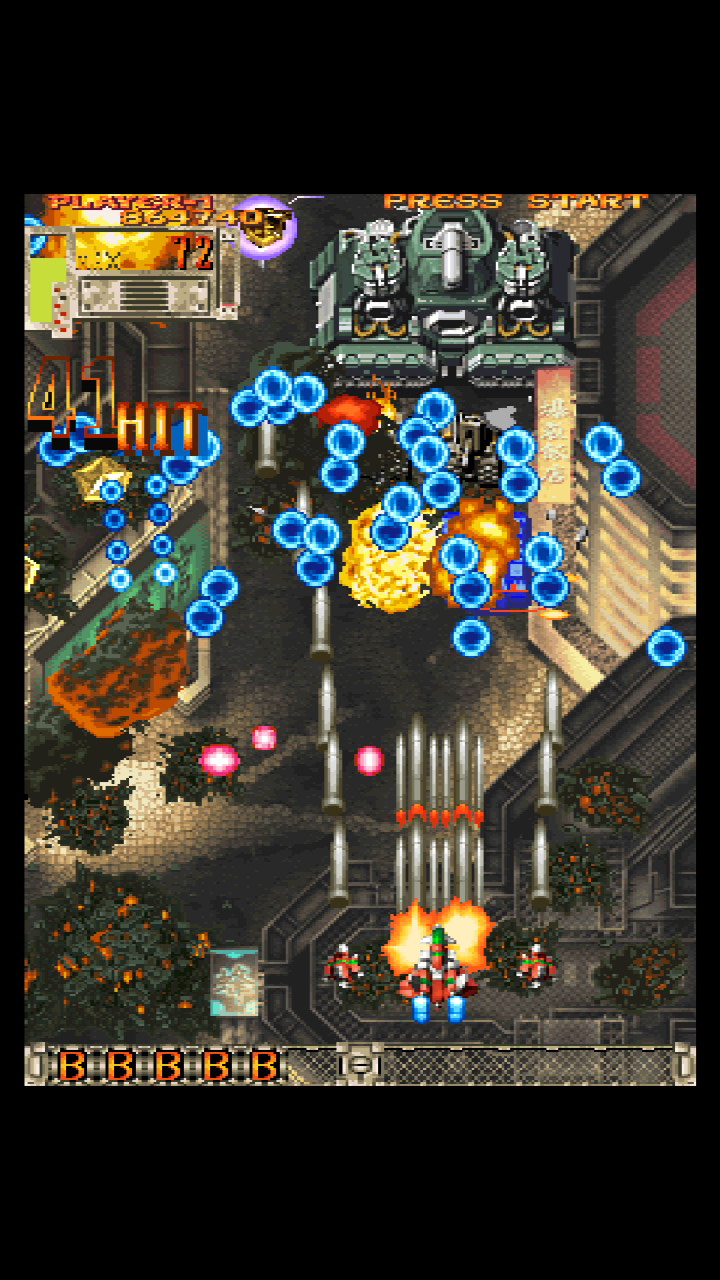
At the peak of their popularity from the mid-80s to the mid-90s, a kind of prototypical image of these games forms in the familiar player's mind--in my own case here I think of the works of Compile, Irem, Toaplan, Tecnosoft, Seibu Kaihatsu, NMK, Psikyo, and of course Cave and Raizing, just to name a few. A dominating motif emerges in this image and in these games--a single-person fighter-craft does battle across a series of stages against a seemingly insurmountable enemy force, overwhelming in both numbers and firepower. The lone fighter meets this vast army with--increasingly, as the genre progresses--overwhelming firepower of its own.
The opposing army against which the player is pitted varies in theme and imagery from game to game. At perhaps the far end of the fantastical we have the Giger-inspired biomechanical horrors of the Bydo Empire in R-Type--though anyone who knows their Giger or their Alien knows that the Bydo have a closer connection to humans and our anxieties around embodiment, sexuality, and reproduction than first appearances may suggest. At the other end of the spectrum, the enemy takes on a more familiar form as a mechanized military force consisting of tanks, aircraft, and warships, typically dressed with a degree of sci-fi abstraction (be it futurist like in Raiden or Dodonpachi or retro-futurist like in Steel Empire or Jamestown) that serves the overall purpose of obfuscating the enemy's association with any particular real-world nation.
This layer of abstraction, however, is not an ironclad rule and earlier entries in the genre often omit it entirely. In 1984, for example, when Capcom began to turn their eye towards the booming American arcade market, the Japanese developer produced 1942, which not only takes for its inspiration the historical Battle of Midway but puts the player at the controls of a Lockheed P-38 Lightning and tasks them with attacking waves of Japanese Pacific forces with the overall goal of reaching Tokyo.
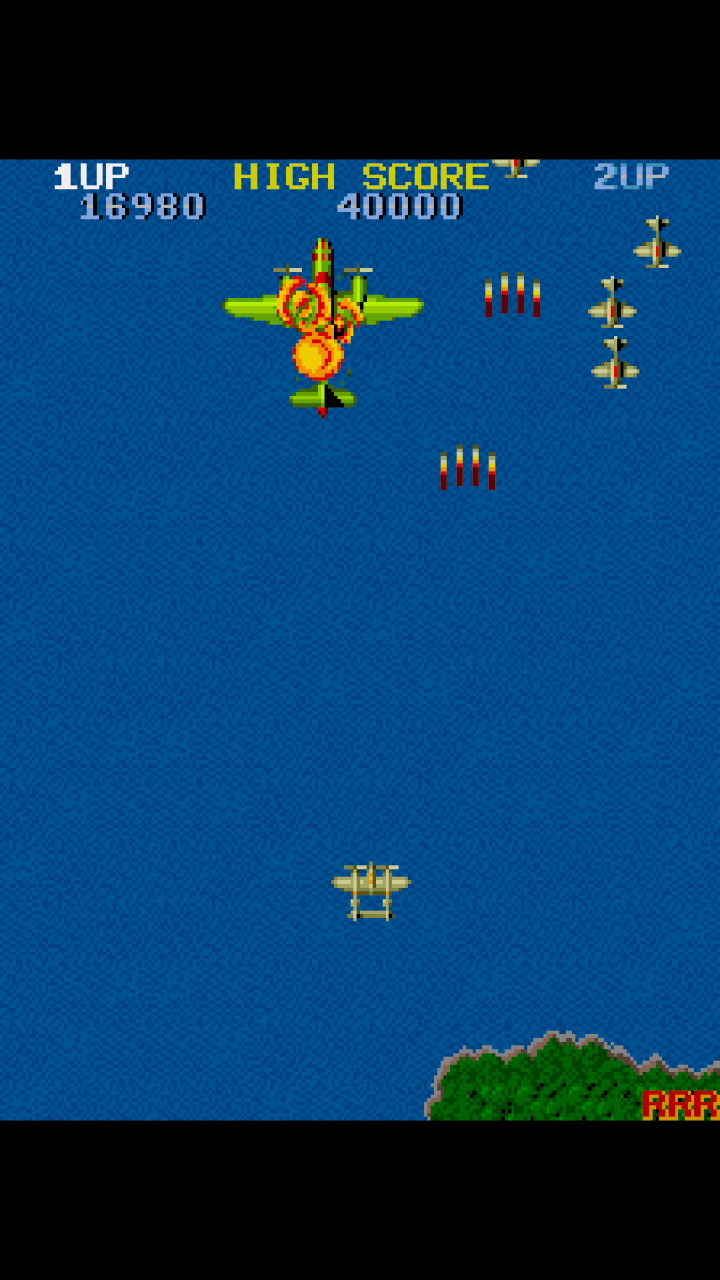
I think it's significant here that near the beginning of their path to becoming one of the largest and most successful video game developers and publishers in the world, Capcom sought their fortune through the lens of an explicitly western power fantasy in the form of a lone, heroic American pilot facing down the full military might of Imperial Japan. And fortune is exactly what Capcom found with this venture--1942 was a hit, became the first Capcom game to generate sequels (five of them, if we stick narrowly to arcade releases), and arguably paved the way for their many later successes, from Mega Man and Street Fighter to Resident Evil and Monster Hunter.
One of the central mechanical expressions of the "power" aspect of power-fantasy in shmups is a progression in firepower where the player's fighter-craft gradually earns the ability to fill the screen with an increasingly large number of offensive projectiles as the game advances. Some games (Raiden being a prototypical example) accomplish this with a system of collectible power-ups which increment the player's offensive capabilities for as long as they can avoid colliding with a hazard and losing a life. Others incorporate a level-up system (Radiant Silvergun being an especially involved example), and a smaller number of games (such as Toaplan's final release Batsugun), use a combination of both. 1995's Tyrian incorporates a shop between levels, possibly derived from early Sega cute-em-up Fantasy Zone but escalating to ludicrous proportions with a huge roster of different weapons for different parts of the ship. This power progression, in all of its permutations, is also a feature Jayanth (2021) ties directly to the foundations of white protagonism: "they accrue more and more power as they 'progress' through the game, mirroring a colonial idea of human progress as linear from 'savagery' to 'civilisation'".
1942, as a relatively early game in the genre, has a comparatively constrained power-up system--by gathering collectibles, the player can supplement their default forward-firing machine gun with a variety of effects ranging from doubling the number of projectiles the plane fires from two to four, depriving the enemies of their ability to fire, gaining a pair of wingmen (who are vulnerable to being shot down), or earning an extra life. None of these bonuses rivals the offensive power on hand in the works of Cave in their halcyon days, and the game remains a very stiff challenge all the way through.
Even so, power fantasy and white protagonism are at their core ideological functions which may be expressed mechanically, but which are not inherently bound to any one particular mechanic. 1942 never goes so far as to hand the player firepower on the scale of a mid-90s bullet hell shmup, but its core framing challenges the player to aspire to a kind of mastery where the same result--annihilation of the enemy--can be achieved through raw skill. This lionization of the white, western-coded ace fighter pilot as a larger-than life bulwark against an onslaught of imperial tyranny (though never, of course, against the empire he serves) is a motif that runs through the whole of entertainment media. One need only look to Luke Skywalker, the plucky farmboy who blew up the Death Star with his eyes closed, or Mark Hamill's other alter-ego, Christopher Blair, the player-pilot who takes on the Kilrathi Empire through the whole of the Wing Commander series of space flight sim games, for ready examples of the same idea.
While 1942's explicit Pacific Theatre framing renders this connection fairly stark, the shmup genre's entanglements with white protagonism and power fantasy go further back than this. So too do power-ups, and here 1981's Galaga offers us a very well-known early example in the form of the double ship. The conceit is as simple as it is elegant: let one of the big aliens at the top of the screen (a "boss Galaga") swoop down and capture your ship with its tractor beam, temporarily forfeit the life, and use your next ship to rescue the first ship by destroying the boss Galaga on its attack run while also avoiding destroying your own captured ship. Your reward for fulfilling this tricky bit of play is the ability to pilot both ships in side-by-side formation, with double the firepower but also double the hitbox width.
By the standards of the time, this is a frankly bullshit level of firepower, and you will cut through waves of aliens with ease for as long as you can avoid taking a hit to either of your ships. It's also an incredibly literal and goofy way of powering up--two spaceships duct-taped together--and I don't point this out as a fault. It's something that just works in the abstract setting of the game.
That's not to say that Galaga is nothing more than a goof. Art Maybury (2021) postulates that the abstraction is the distraction:
"Galaga's moral universe, like that of Berzerk [1980], is one scrubbed clean of any justification or specifics or externalities, a depiction of free-standing conflict, where nevertheless you end up automatically siding with the one you control who's outnumbered."
Art makes three significant observations in her time with Galaga: it is visually stunning, it is hard to put down, and even within the constraints of its spartan canvas there is enough imagery to suggest that the player ship is pitting a self-destructive unilateral assault against an alien force in full retreat. At several points she highlights how easy Galaga is to play relative to its contemporaries: "it's the cultivation of that intoxicating ego-stroke of making it to the fourth wave on your very first try." While it's still a quarter-muncher that will kick a novice player off the machine with period-appropriate punctuality, it's also a game that reveals its friction somewhat gradually, initially giving you just enough of an on-ramp to make you feel like a ringer.
I wonder if this final point about Galaga--the exhilarating ease of its power fantasy--goes some way towards explaining why I've always found the draught of Galaga's immediate predecessor, Galaxian, a bit more to my taste.

Galaxian is perhaps my favourite of the early fixed-screen space shmups, and I appreciate why that's not a particularly defensible position to take. On both technical and experiential levels, Galaga is the better game. Taken in terms of both historical significance and advancement of the genre, Art has it right in dedicating an article to Galaga and consigning Galaxian to the footnotes as one echo among many of its immediate forerunner Space Invaders.
Even so, Galaxian is the game I go back to more often. It's the one that hits, and part of this is because it's not as smooth as Galaga. It's a slower, harsher game, and when I play it, I feel very differently than I do playing Galaga. And while it lacks the particular historical pantomime of something as overt in its inspirations as 1942, Galaxian nonetheless gives me something further to consider when it comes to gaming's long association with white protagonism.
Let me unpack that initial point about Galaxian being a slower game than Galaga with an anecdote. There's a line in Armored Core VI: Fires of Rubicon that my friend Kaile Hultner comes back to often in conversations about the game, where rival/war buddy/love interest (?) V.IV Rusty is charging up a giant railgun several miles away with the aim of incapacitating an enormous, rampaging, tunnelling worm mech. Just as he's about to take the shot, he makes a promise that he immediately fulfills: "I won't miss".
It's the emotional climax of the middle act of the game for a series of overlapping reasons: the worm is easily the greatest threat the player has encountered up to that point in the game--so much so that the warring corporate factions that guide much of the game's conflict have come together in a temporary truce to deal with it--the mission up to that point has involved carefully setting up the worm for Rusty to take his shot, and Rusty is himself the kind of incredibly likeable character that you root for even when you're in direct conflict with him. The coolest guy in the universe just landed a Hail Mary shot against a potentially planet-destroying threat, you helped set him up to do it, and he thinks you're not so bad yourself--even if you might have to kill each other later.
Every shot in Galaxian feels a tiny bit like that shot--not thematically, of course, because you're missing all the character development and hot yaoi strife--but mechanically. To establish some context for that, as part of their gradual power creep, shmups have largely abandoned any semblance of asking you to count your shots--you just hold the fire button and the front end of your ship becomes a bullet hose. This was not always the case; a great many older shmups impose an upper limit on the number of projectiles that are permitted to exist on the screen at once. This is why when Hamster releases an old shmup through its Arcade Archives label, they give you not just a turbo option, but the ability to dial in how fast that turbo fire will activate--crank it up to max, and you'll quickly find your shots rattling off in tight, wasteful bursts, while you wait for the salvo to clear the screen before you can fire again.
Galaga, for its part, permits two player shots to exist on the screen at once, and in its own frame this is something of a sweet spot--it affords a measured and intoxicating balance of button mashing, which Art calls "the poetry of the twitch". Galaxian, the older game, is built different--only one player shot on-screen at a time, a constraint it has in common with Space Invaders. This ensures that your rate of fire is much slower, and necessitates that it is much more considered. You spend at least as much time in Galaxian aiming as you do firing. Missing is all the more painful because of the time you have to wait between shots. You don't want to miss.
While this restriction is inherited from the aforementioned Space Invaders, it feels more significant in Galaxian. In Space Invaders, the projectile is small and quick--it's still infuriatingly easy to flub it and have your shot pass harmlessly between columns of advancing aliens, but recovery is a little quicker. In Galaxian, the projectile travels a little more slowly, and it's much larger. I'm also reasonably persuaded that it's a tangible object. It is a tall, slender shaft, of unknown composition, and its physicality is implied by the fact that it sits primed at the bow of your ship when it is ready to be fired. It is the fer-de-lance--the iron of the spear.
Let me demonstrate why this is significant by way of another analogy from mecha. Early on in the manga/anime Knights of Sidonia, the last remnants of a spacefaring future humanity are threatened by a shapeshifting alien race called the Gauna. The only weapons that can kill Gauna are the kabizashi, mech-wielded spears tipped with a unique and incredibly rare alloy. This alloy is so scarce that at the start of the series there are only 28 remaining kabizashi in existence. This creates an enormous amount of tension in the early combat encounters in the series, since every strike counts and losing a kabizashi is arguably a greater setback to humanity than losing the pilot. You don't want to miss.
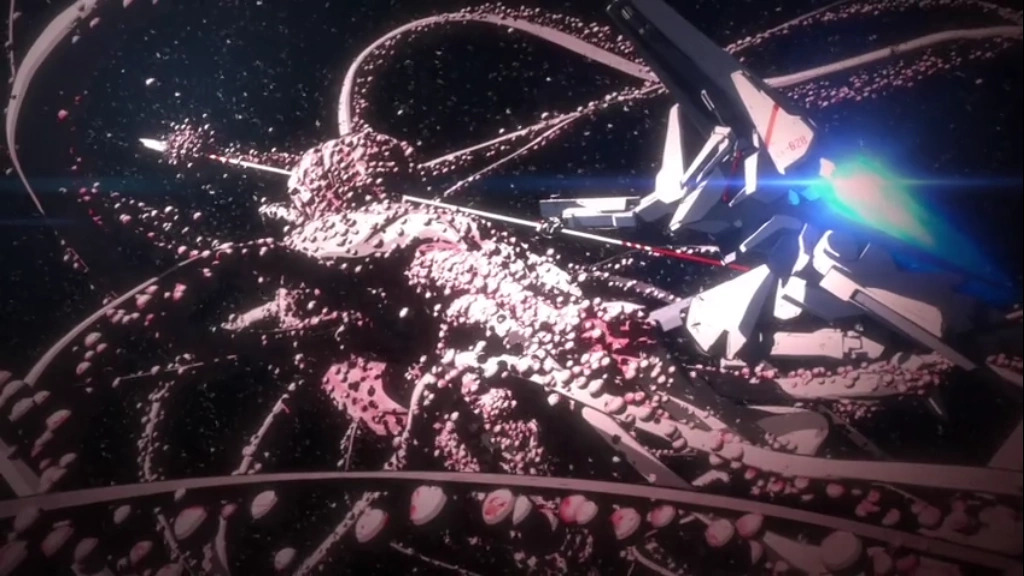
Eventually the series moves. . . well away from much of this initial framing--for instance, humanity eventually figures out how to mass-produce the material the kabizashi are made out of and they very naturally start making bullets out of the stuff. Those initial episodes, however, are memorable because like Galaxian, they operate in a wider genre where ammunition is less than an afterthought and heroes start powerful and just get more powerful. In both of these counter-cases, the protagonists feel distinctly underpowered.
An underpowered fantasy, however, is still a power fantasy--the thrill comes from the feeling of overcoming a superior force. Nagata Tanikaze becomes the pride of Sidonia in his fights with the Gauna, outpiloting and often outliving his more experienced peers. The P-38 challenges the full might of the Imperial Japanese Air Service to take the fight to Tokyo. The Galaxip strikes down its alien foes, one throw of the great spear at a time. Jayanth (2021): "The white protagonist experiences limitation of their power solely in order to overcome it".
Galaxian also has a very clear thematic overlap with something Art identifies in Galaga--the scrolling starfield suggests an enemy in retreat, rather than on the offensive. In both games, the insectoid aliens spend most of their time facing away from you, only turning around when they break formation to take a run at you--they are very much fleeing! Galaga's more dynamic enemy formations and twitch-oriented rhythm do much to obfuscate the idea that the aliens are running defense--it's an easy thing to forget amid the thrill of play. Under Galaxian's steadier rhythm, where every shot is considered and counted, the conflict takes on a different cadence. At times it feels a bit more like an execution.
This is a point of departure from Space Invaders. Unlike either of its Namco successors, Space Invaders unambiguously casts the player as the defending party, with the waves of aliens marching steadily downwards, gun-end always pointed towards you. The invaders do not flee. The progression of the game further takes on more of an air of doom compared to its successors--if the player isn't blasted from the air outright by the advancing aliens, the only other possible outcome of the game is for the aliens to inevitably reach the ground, implying game over not merely for the player but for Earth as a whole.
What unites all of these games--and indeed, shmups as a whole--is their use of the last stand as a narrative frame for the action. Underpowered or overpowered, rapid fire or single shot, shmup protagonists are always the last best hope of a heroically put-upon people.
In Galaxian the last stand resolves as a kind of paradox, as the lone Galaxip takes an eternal fight to an ever-retreating alien force, but the last stand is itself a paradoxical trope predicated on omission. You cannot engage in the mythmaking necessary to elevate a Custer to the level of American folk hero without pushing the broader American campaign of annexation against the Lakota Sioux and Northern Cheyenne nations out-of-frame. While the passage of time has allowed for some critical re-examination in the particular case of Custer, we continue to be drawn to these stories in our popular media. Leonidas hurls his great spear to wound and spite the face of God before he is struck down in a hail of arrows. Doomguy is the last man standing between Earth and the forces of Hell. Jayanth (2021) writes on the lone hero: "It is a white fantasy, and an imperial one -- the fantasy of saving the world is in fact necessary to conquering it, and has provided 'moral cover' for brutal conquests and wars in the real world."
While shmups are almost uniformly short games, owing to their origin in and enduring association with the arcade, many are also looping games, sending players back through the same sequence repeatedly or even infinitely. Cave's games are (in)famous for their second loops which feature not only significantly harsher challenges, but often story revelations culminating in a "true last boss" (TLB). Galaga technically has a kill screen where the game stops working, similar to its sibling Pac-Man, but only if you can stick it out to stage 255, by which point the player will have cycled through the full series of "challenging stages"--intermissions where aliens dance across the screen in difficult-to-hit patterns without firing a shot--eight times.
Galaxian has no kill screen. It stops counting flags, which denote the level you're on, after 48, but the game cycles on endlessly. After remarking on the awe and horror of Armored Core VI's twists and turns over its own three narrative loops, Kaile Hultner (2023) turns to the infinite postgame, as the texture of the story recedes into the cosmic filament and the player's identification with the protagonist as an embodied subject fades to noise. They conclude, "Their will is our will. Their future is what we have envisioned for them. They are simply a gun that never misses, and we now pull the trigger." After countless hours of practice and skill refinement, with no intermissions of dancing aliens to break up the steady march as the player follows an asymptotic trajectory towards an event horizon of pure gameplay, Galaxian resolves to the same interminable conclusion and the player dissolves into the system entirely.
References
Althusser, L. (1971). Ideology and Ideological State Apparatuses (Notes towards an Investigation). Lenin and Philosophy and Other Essays (B. Brewster, Trans.). Monthly Review Press. (Original work published 1970)
Dyer-Witheford, N., & de Peuter, G. (2009). Games of Empire: Global Capitalism and Video Games. U of Minnesota Press.
Hardt, M., & Negri, A. (2000). Empire. Harvard University Press.
Hultner, K. (2023, September 26). A Gun That Never Misses. No Escape. https://noescapevg.com/a-gun-that-never-misses/
Jayanth, M. (2021, November 30). White Protagonism and Imperial Pleasures in Game Design #DIGRA21.Medium. https://medium.com/@betterthemask/white-protagonism-and-imperial-pleasures-in-game-design-digra21-a4bdb3f5583c
Maybury, A. (2020, August 10). Galaga [1981]. Arcade Idea. https://arcadeidea.wordpress.com/2020/08/10/galaga-1981/