Horses
December 3, 2025
Content Notification for mentions of rape and sexual assault
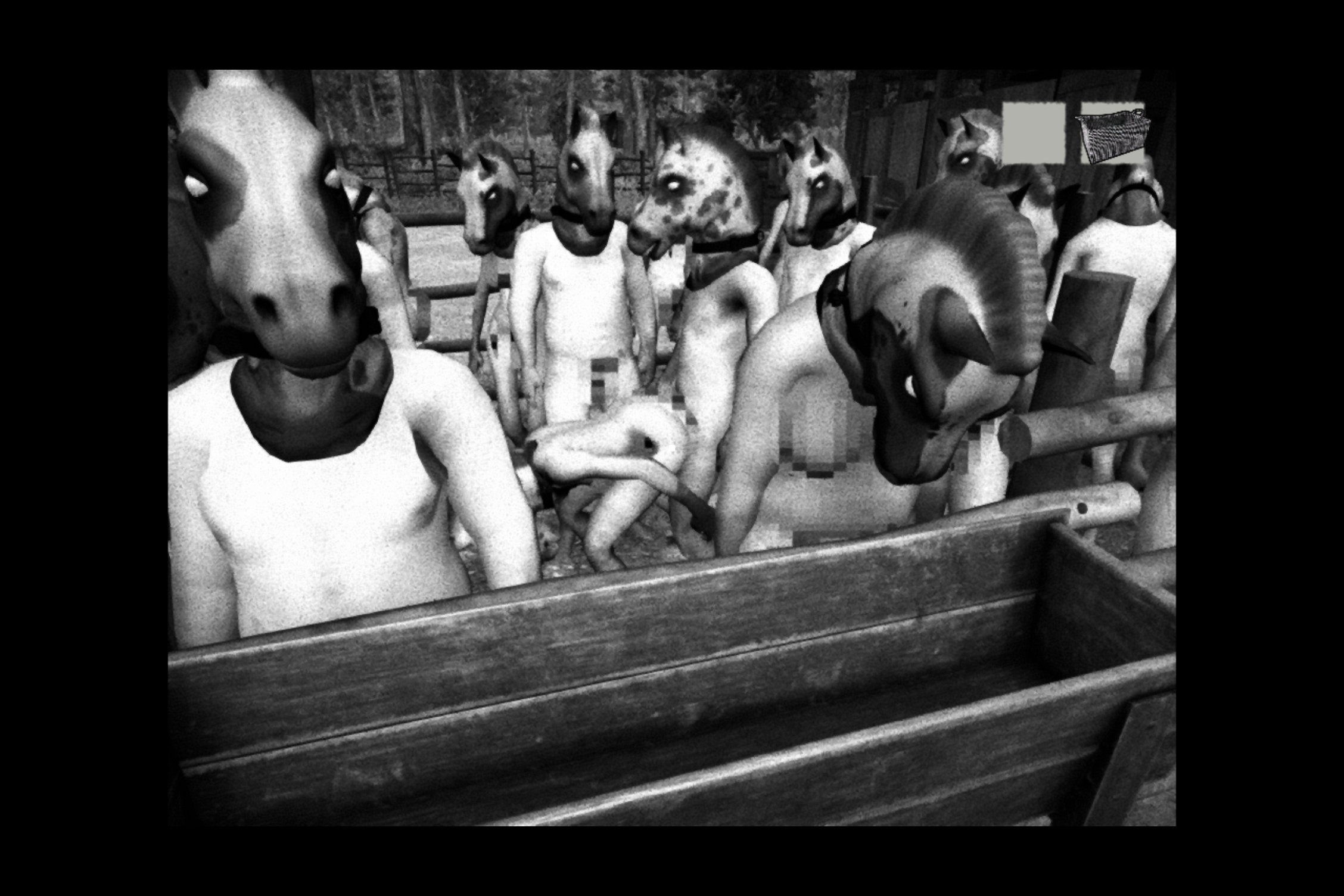
Horses is a game available for purchase--at the time of this writing--on Good Old Games and Itch.io. It is also the latest discourse firestorm in gaming circles and has attracted a lot of attention in the games press, initially for being refuesd certification on Steam, and subsequently for being yanked from distribution by the Epic Games Store and Humble Store. The game operates primarily in the register of silent film, with a monochromatic presentation, dialogue cards, and almost no sound save for its ominous score and the relentless, oppressive rattling of a projector reel. Horses nominally presents itself as a light farming sim on a horse ranch with a horrific twist--the titular "horses" that you tend to as farmhand protagonist Anselmo are not horses at all, but enslaved human beings wearing nothing but iron collars and horse masks.
While the actual reporting on the game has been diligent, giving primacy to developer Santa Ragione's own statement on the Steam ban and co-founder Pietro Righi Riva's remarks in interviews, misinformation abounds on what is actually in the game and why storefronts are refusing to carry it. Comment sections and Reddit threads alike have seized upon unfounded accusations of child sexual content, focusing specifically on an early test build--not present in the final game--of a young girl riding one of the human horses as though they were an actual horse.
Let me nip that one in the bud right there. Any player who is not wilfully suppressing their critical faculties in service of a bad-faith reading will come away from Horses with full understanding that there is no sexual connotation--intended, interpretive, or otherwise--to riding upon the shoulders of a human slave for amusement. This is not to say, however, that Horses is devoid of sexuality. On the contrary: sexuality is among the game's dearest concerns.
Let me make this very clear: I have no special insight whatsoever on what the actual decision-making process was at Valve--not even Santa Ragione do, as they have resorted to guessing at what storefronts might have deemed objectionable and adjusting their game accordingly. Having completed the game myself, however, I have my own guess.
Horses was not banned because of its sexual content, but because of its sexual commentary.
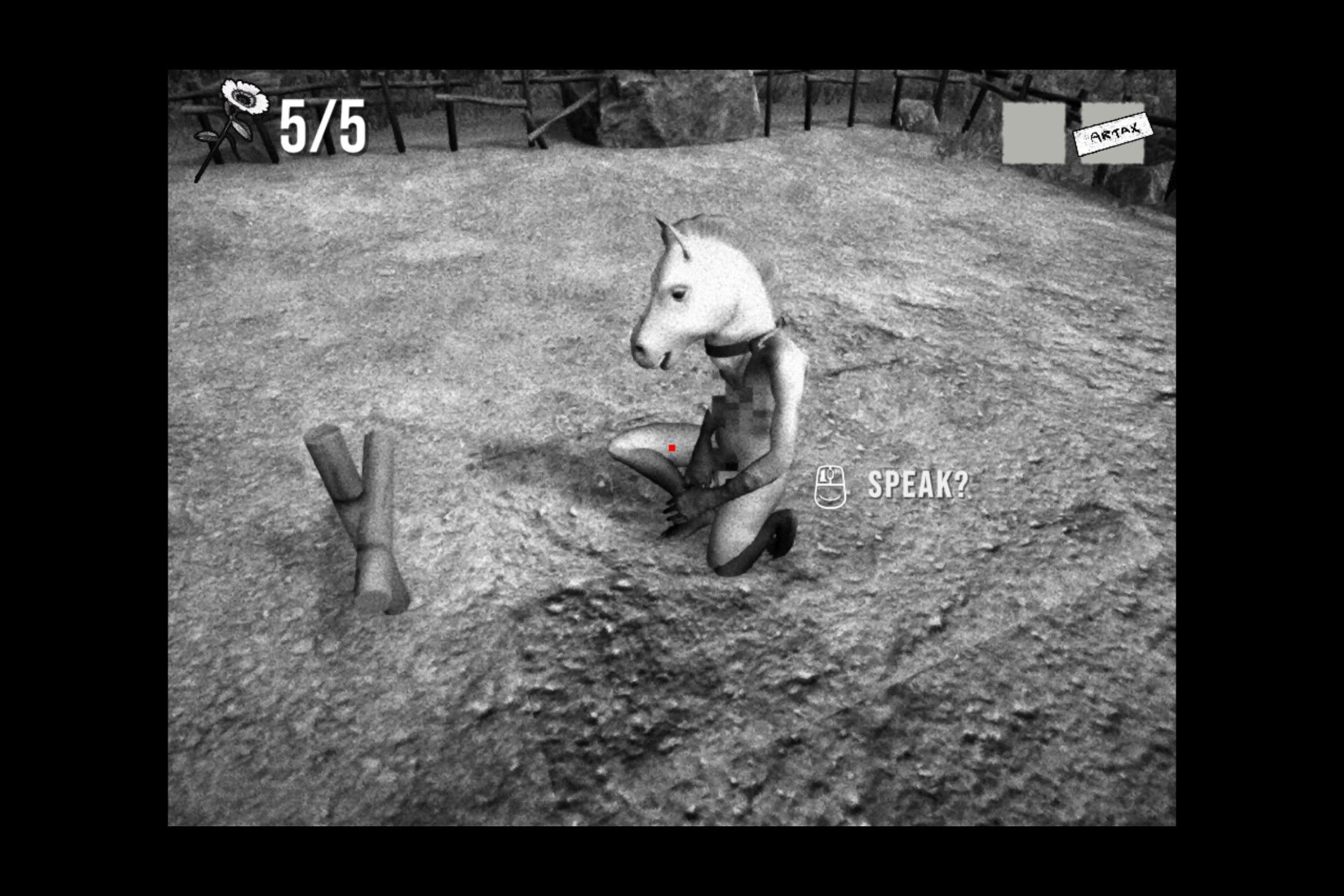
While the allegories for fascism in a story where specific categories of human beings are persecuted, abused, raped, killed and completely, literally dehumanized are obvious, Horses focuses its attention very narrowly on sexual mores as the primary mechanism of class division in its world. Midway through the story, a wealthy young woman visits the farm to purchase a horse. As Anselmo leads her about the corral for a ride, the woman acknowledges the ruse for the first time in the game: the horses are not "real" horses, but people who have been enslaved as punishment for deviant behaviour. The woman is discreet and nonspecific as she rationalizes the mass-manufacture of human suffering as necessary for the maintenance of social order--and for the perpetuation of her father's sizable business profits.
It is the farmer who confirms in explicit terms that social order and division are both maintained through the relentless surveillance and policing of sexual morality. On his farm, "fornication" among the horses is strictly forbidden, and Anselmo is tasked with reporting any transgressions that he sees. One evening early in Anselmo's tenure, the farmer recounts a story from his own childhood where his father forced him to hold down his own dog to be castrated after offending the sensibilities of a priest. This story foreshadows an event later in the game where the farmer similarly forces Anselmo to hold down a horse--Gramo--to be castrated after he is accused of raping another horse--Asmara--to death.
Like any totalitarian regime, the power hierarchy of the farm is riddled with hypocrisy. It is not Gramo--clearly in mourning and distress--who violates Asmara, but the doctor called upon to treat her. Likewise, the entire social structure of the farm finds its origin in the heady mixture of the farmer's strict religious upbringing and the thwarting of his teenage lust for a young woman named Bianca. Justice is not blind here; it is paranoid and vindictive. When Bianca spurns the farmer in favour of a young man named Primo, the lovers are enslaved as horses under the farmer's watchful eye.
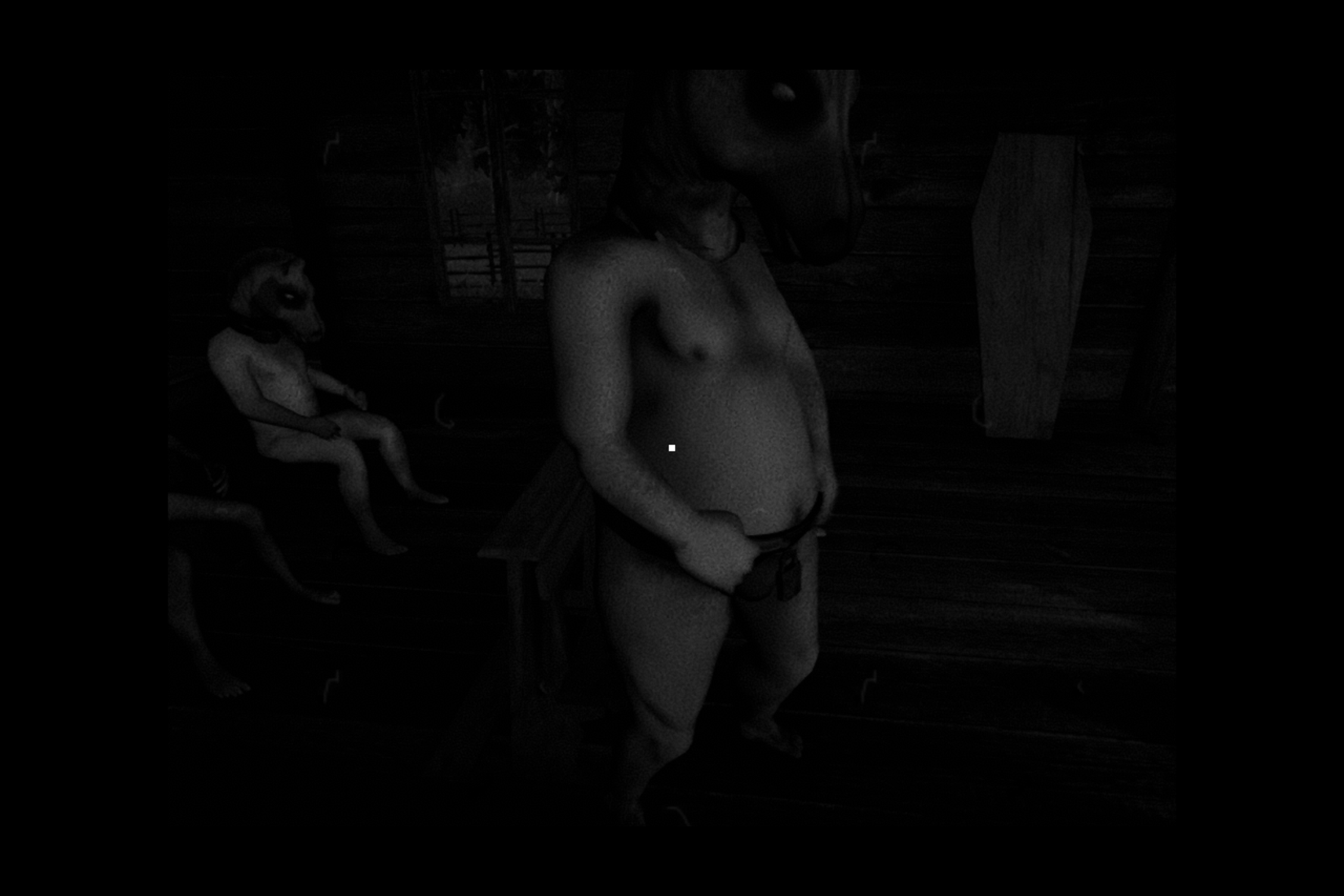
It is also worth observing that the farmer, too, is a sexual deviant, or what this world would regard as one: he is a voyeur. The game's night sequences--some more dreamlike than others--feature the farmer stripped down to a chastity belt and--in another note of foreshadowing--a horse mask. He never directly participates in sexual activity throughout the game, but rather stimulates himself as a witness to others. His particular fetish dovetails thematically with the panoptical paranoia with which he rules his farm, and his fascination with cinema shapes not only his mechanisms of control but bleeds into the very presentation of the game.
Horses thus sends a loud message that sexual persecution is an instrument--perhaps one of the principal instruments--of establishing and preserving totalitarian order. Surveillance, propaganda, and violence--hypocritical, sexual violence--are all leveraged in the name of scouring sexual subversives--or even just a woman who said no to the wrong man--from polite society.
In this context, perhaps it becomes a bit less mysterious why Steam, Epic, and now Humble would refuse to host the game for sale on their storefronts, offering explanations ranging from nonspecific foot-shuffling to complete silence when questioned. The way I see it, Horses was not banned from these spaces because it depicts or implies human beings fucking or even committing sexual assault--it was banned because its message is a black eye to merchants who in the past year have to their own humiliation enabled social conservatives and bigots to dictate the boundaries of acceptable sexual content--and acceptable creators--on their storefronts.
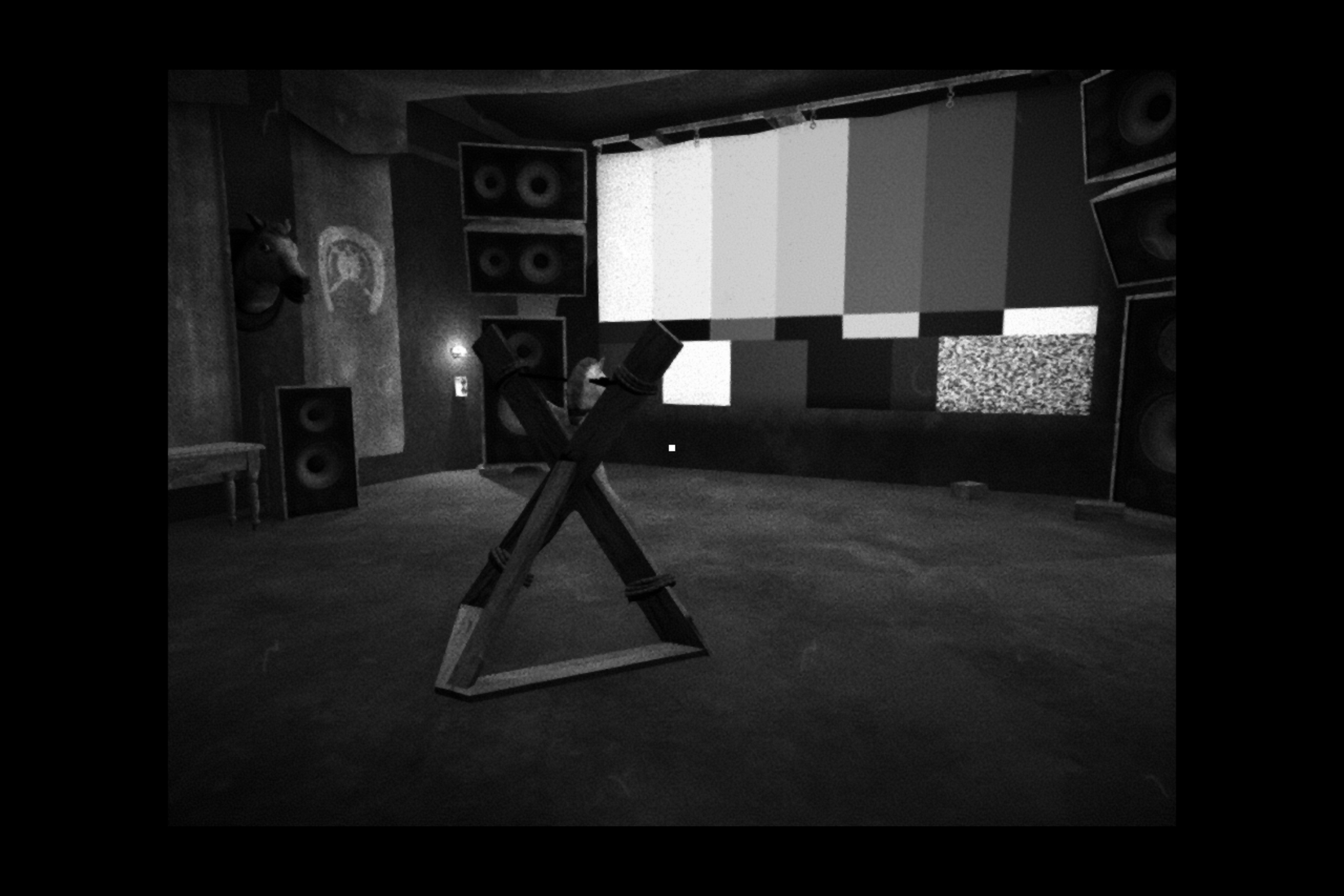
For all of its fire, the conclusion of Horses is a hopeful one. The tyranny of the farm is overthrown, a colossal film projector is found, and its relentless ticking reel is cut; the final castration of the game is, appropriately, that of the regime and the media ecosystem that props it up. At long last, sound and colour begin ever so gradually to seep back into the world. The horses observe a funeral pyre for Fiero, the first revolutionary, and the one to put Anselmo on the path to rebellion. At the funeral's conclusion, Anselmo puts on Fiero's mask, but its symbolism as an instrument of oppression has by now fallen away--the mask now confirms Anselmo's own liberation from the oppressive social order in which he was once both victimizer and victim. Even the farmer, Piero, finds redemption and liberation in his own way; once he is given the serum used to transform people into horses, he too assumes the mask for the last time, and joins the herd in their march to freedom, striding forward in his chastity belt.
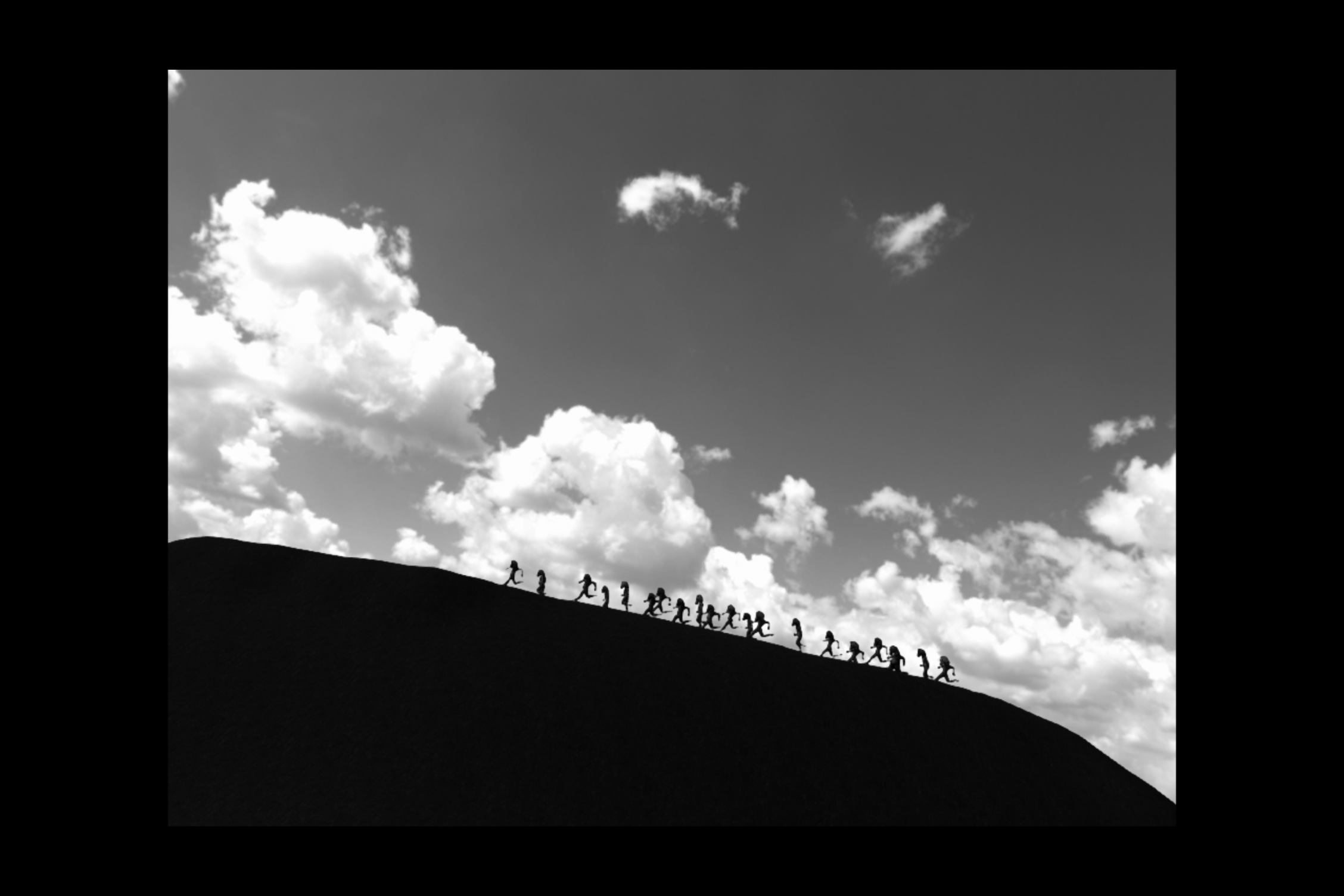
It is a remarkably radical conclusion, where all class divisions fall away. The final shot of the game is of the now-freed horses climbing a hill, silhouetted against the bright morning sky.