Camera Lakitu
March 28, 2026
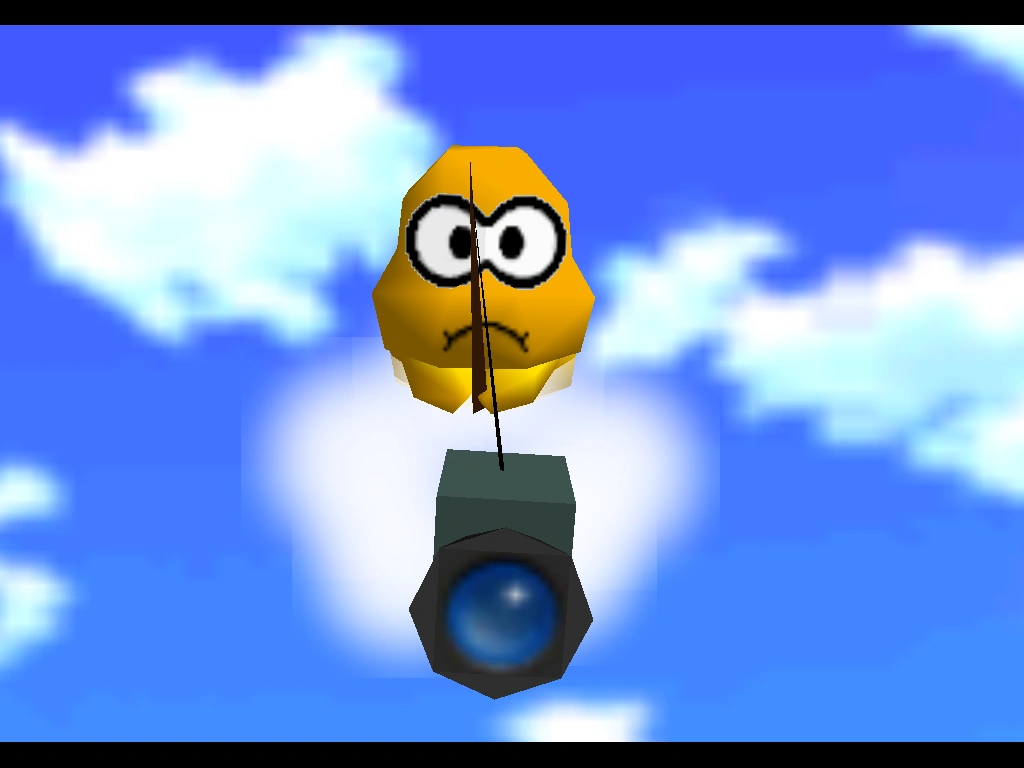
Something that lingers in my memory from game reviews in the late 90s is a strong focus on the camera. It feels like we were always complaining; complaining about its imprecision, its clumsiness, its tendency to get stuck on walls or complicate the prerequisite trigonometry to safely navigate a jump.
I think all of this complaining is understandable. Gaming's foray into 3D worlds marks a time where we were all kind of new at this--learning how to walk, to run, to explore in ways that demanded new proficiencies compared to what had come before. This segue also marks the first time, I'll wager, where many of us were consciously aware that games were mediated by camera, by frame, by composition in the first place--and indeed always have been.
We don't talk all that much about videogame cameras anymore unless you're a designer. It's not that virtual cameras have gone away, or diminished in importance, but in large part they have ceased to draw attention to themselves as a remarkable point of friction in the interface. Modalities have shifted: far more games now employ a first-person perspective, reducing the visible span between protagonist and perspective. Even third-person games have standardized a much finer resolution of camera control; the right analog stick does exactly one thing and it's disgusting.
But in the 90s, all these tools and paradigms were new, for designers and players alike. They drew attention to themselves by virtue of their newness, and they were beautifully imperfect.
In developing Super Mario 64, Nintendo anticipated that players would kind of struggle, at least at first, to understand the form and function of the camera in 3D space. So they did the most Nintendo thing anyone might have done in this scenario.
They personified it. Enter Lakitu.
On one hand, I think it's very funny that Nintendo thought to take this extra step at the exact same time that they shipped a three-handed controller. Even so, Lakitu is a stroke of brilliance.
The teaching aspect is one thing, and that's fine: giving the camera a face and a voice builds in a bit of extra opportunity to tutorialize the controls for new players. But this isn't the remarkable bit for me.
What's remarkable is that Nintendo also gave Lakitu a mind of his own. They gave the little fella notions.
Lakitu is not just a piece of equipment with eyes, nor is he just a pair of hands to hold the equipment; he is a cinematographer. By default, he is the principal decision-making force in how to line up a shot, how to frame a landscape, and, at least in the domain of the visual, how to tell a story.
In the story Lakitu tells about the game's first world, Bob-omb Battlefield, the main character is not Mario, but the mountain, which is nearly always in-frame. The lower Mario's elevation in the world, the lower the angle. If Mario sticks closely to the path, Lakitu almost never chooses to follow his ascent from directly behind, instead favouring more side-on perspectives which keep the mountain in view. He swings low as Mario scrambles up the first bridge. He takes a step back to capture the scale of Mario's first significant adversary, the prowling Chain Chomp, and both in turn are towered over by the brooding mountain. On the field before the mountain gateway, he takes a break from the mountain to swing a little higher, to better frame the bubble bombs raining down on Mario. When the threshold is crossed, Lakitu opts for a low-angled, spiraling ascent, building anticipation for the summit. When Mario reaches the peak at last, Lakitu swings high once more, juxtaposing Mario's smallness against the grassy mesa.
If left alone to work his magic, this is the story Lakitu tells, and by letting him cook we begin to understand something about his style and taste. He is fond of tracking shots, but has little love for right angles. He is fascinated by perspective and never misses an opportunity to highlight the vastness of the world. If Mario dies, Lakitu betrays a voyeuristic impulse as he zooms in on Mario's X-ed out eyes. Little freak.
But as is often the case, Lakitu's dominance is unlikely to go wholly uncontested--he is likely to bicker at times with the director. While you could make the case, as Michael Nitsche (2005) does, that the player controls both Mario and Lakitu, there is a vast gulf between the two in terms of both resolution of and resistance to that control.
Mario 64 is the 3D platformer, the game where the developers famously spent the bulk of their time just tweaking Mario's movements on an empty grid, and the Nintendo 64's uniquely cumbersome and fragile analog stick remains so integral to the experience that speedrunners have been trying to re-engineer it from first principles for over a decade.
Yet we must also bear in mind that the whole of the Nintendo 64's not-quite-made-for-humans controller was purpose-built for Mario 64, not just the stick. Moving from the Super Nintendo, Nintendo expanded the number of face buttons from four to six, and at the same time reserved four of those buttons for camera control: the compass rose of "C" buttons.
Two values are communicated in this design: an outsized attention to the control of the virtual camera, and a sharp contrast in the resolution of that control with the analog stick.
Here is the distinction laid bare. With a bit of practice (and a well-maintained analog stick) the player can direct Mario around the set with pinpoint precision, and the worlds in the game progress in a such a way as to routinely test that precision and proficiency. With the digital C-buttons, no such precision is afforded. They only allow you to tell Lakitu in a general way where you want him to go. In doing so they introduce delay, as Lakitu hurries over to the appointed area, and imprecision, since each press of the button accounts for a wide truck around the subject, let's say 60 or 70 degrees.
Then there's resistance. Remember, Lakitu is a cinematographer with Notions, and the director yelling at him to take up another position does nothing to erase those notions. As soon as Mario starts moving around again, Lakitu resumes making his own decisions about how to capture the proceedings. Sometimes these are microadjustments, just the necessary movements to keep Mario in frame and in proper situation with his surroundings, but very often Lakitu will begin to drift back to his preferred angle. You can always bark at him again to take up another post, but obedience is only ever partial and fleeting.
Playstyles will naturally vary, but Super Mario 64 is defined in large part by this dialectic in real-time, by endless bickering back and forth over the set between director and cinematographer.
We don't talk much about videogame cameras anymore, I began earlier, even if they're still there. When reviewers complained about the camera in 3D platformers, they were calling attention to this clash on the set, to the conflict between director and cinematographer, to the videogame as a production not wholly under the player's control. Videogame cameras haven't gone anywhere, but I think cinematographers have gotten a bit more rare. Nowadays our thumbs seldom leave the right stick, but our attentions alight upon it with far less frequency.
References
Nitsche, M. (2005). "Focalization in 3D Video Games." In Conference Proceedings: Future Play, Lansing, Michigan (13-15 October), https://www.researchgate.net/publication/228387564_Focalization_in_3D_Video_Games