MiSTery Meat
July 29, 2026
[Aesop Rock & Homeboy Sandman - The Burgers]
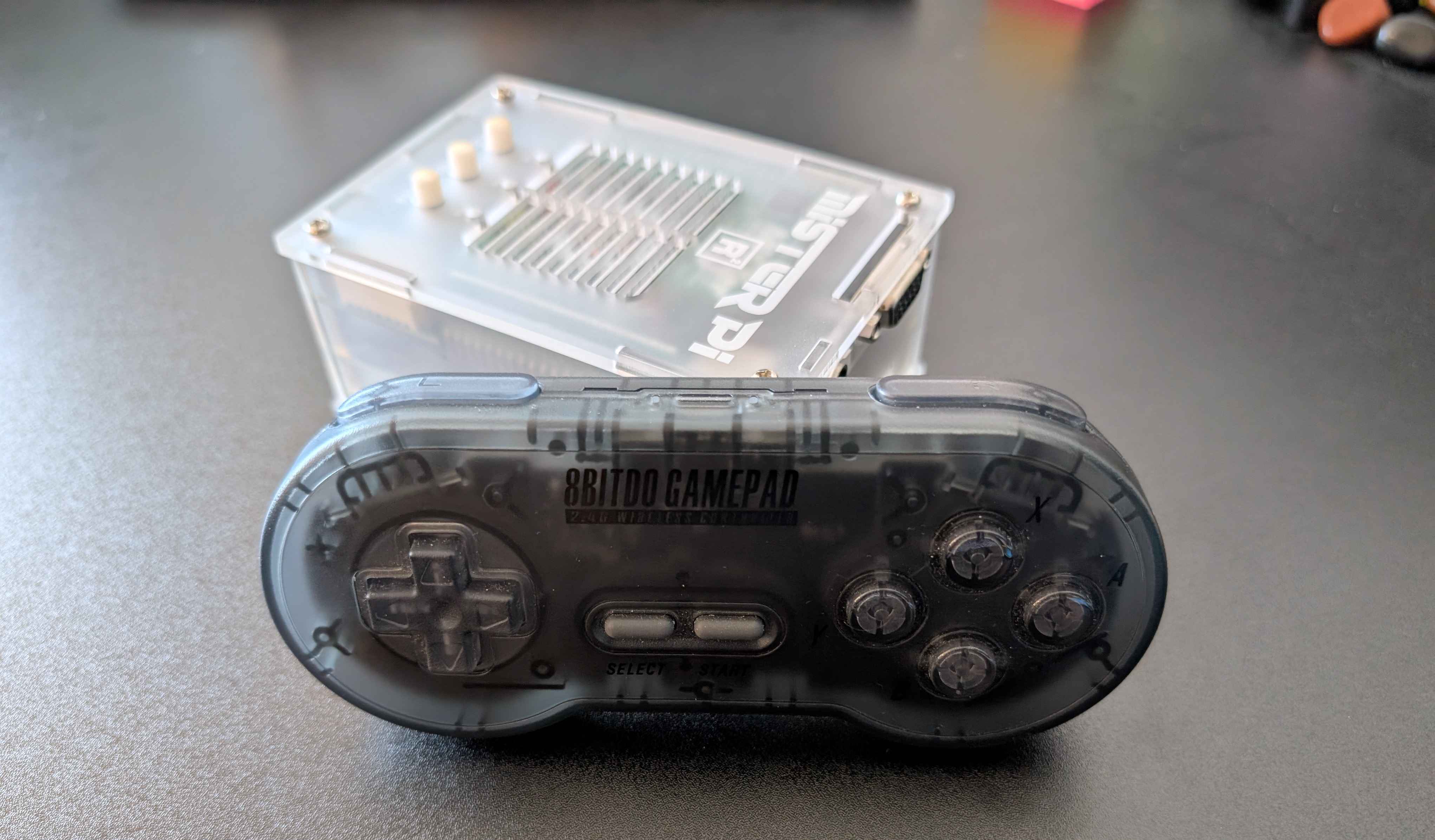
I have a MiSTer. If you haven't heard that term before, it's an FPGA development board repurposed to act as a general-purpose hardware emulator for videogames.
The MiSTer is an incredibly convenient and versatile little box that can be configured to play nearly any videogame up to the N64/PS1/Saturn (and some handhelds that came out after that like the GBA). If that just sounds like "a computer" to you, you're not wrong and I'll come back to that shortly.
In some circles these things have overtaken the previous retro gaming DIY project in vogue a decade or so ago, the Raspberry Pi, which is a single-board computer that can likewise run a wide variety of retro games via software emulation. While initially quite expensive (built as they were around a single brand and model of development board that was never intended for a gaming market), MiSTer setups have gotten somewhat cheaper in recent years with the introduction of clone boards, while the price of Pis has steadily climbed. So that's one draw.
The other main draw of a MiSTer over a Pi is latency, an evergreen topic in retro gaming. In short, it's easier to shave off frames of input delay on a MiSTer, to the point where even a sensitive player is unlikely to notice that something is off on the timing of Mario's jump. It is not impossible to achieve comparable results in software emulation, but it is more difficult.
I'm being reductive about the differences between the two devices in a way that will annoy some people in the scene, and I'm doing that on purpose because there's a lot of snobbery among FPGA users. In particular, some people chafe at the labelling of FPGA hardware implementation as emulation. It is. It operates on a different layer of abstraction than traditional software emulation, and that comes with some perks (namely the reduction in technical hurdles to achieve low-latency results), but both of these solutions for running old software on new(er) hardware depend entirely on the accuracy of the documentation for said hardware and the knowledgeability and skill of the developer writing the emulator. Hold on to that last bit.
Like a lot of open-source software projects lately, the MiSTer scene has been inundated with vibe-coded, LLM-generated emulation cores, often with little to no code review by knowledgeable human developers, mostly for arcade games that have not yet been implemented by said human developers. Some of these cores have been derived from earlier work on the same games for MAME, which is an arcade-focused software emulation project.
This sucks. These are cores that have been copied, without understanding or oversight, from the work of experts. Much of the work for MAME is distributed under very generous public licensing agreements, but not all. A vibe coder initiating a pull request for their bogus core does so with no understanding of the compromises, workarounds, and educated guesses that the original developer made to get a game running in software, and no certainty that Claude-sama has reproduced that original work faithfully, which is not a trivial undertaking even with a human at the wheel. Some of these vibe cores have pre-empted the work of human developers working to implement the same games, in much the same way that shitty machine translations of import games have displaced fan localizations.
Compounding this problem is that these vibe cores have polluted the Update All stream. Update All is, as its name suggests, a software tool for MiSTer that centralizes and manages database updates for all of the major cores, tools and utilities associated with the project.
What this means in practice is that if you run the Update All script on a MiSTer device right now, you're going to get the vibe cores, and you're not going to be able to sort them out from the genuine, human-authored ones.
The developer and maintainer of Update All, theypsilon, has received questions about this situation, but has said that without cooperation from repository maintainers in the community, which he has not received, there is no practical way for him to sort the vibe cores out, or give end users the means to do so. This is an incredibly shitty situation.
Some of the knots the resulting discourse has twisted itself into have been ugly. Some developers are rightfully concerned, and some people just want their toys, ethics and standards be damned. One of the most prominent core developers in the scene, Jotego, came out against this incursion on the grounds that LLM cores are shoddy work that also discourage human research and development in the scene. Jotego also operates a lucrative Patreon, with the primary perk for subscribing being early access to new cores. LLM boosters/fatalists (is there a meaningful difference?) have seized upon this context to accuse Jotego of gatekeeping the scene to protect his revenue stream.
I have no interest in refuting this empty-headed appropriation of pseudosocial justice rhetoric because these accusations do nothing to deflect the substance of Jogeto's critiques. The pro-vibe-core argument is the exact same one that LLM Bros have fielded when they have received pushback in other creative fields--music, illustration, writing, etc. The claim is that Large Language Models democratize creative fields by removing barriers for entry, and- actually no, fuck you, full stop. The "barriers for entry" here are basic knowledgeability of your craft and practice. If you're not willing to cultivate either and still want "your" contributions to be accepted alongside those of the people that actually worked for them, you are a hack that deserves to be laughed off the face of the earth.
The MiSTer project is a valuable undertaking from the standpoint of hardware preservation not because it results in a device that end users can play roms on, but because it has fuelled research into countless undocumented arcade PCBs, some of which are infamously hostile to external tampering and which risk being lost to time without a motivated community of hobbyists working to understand them. That value and that motivation are undermined by the watering down of code quality and the devaluing of expertise.
The MiSTer device is a toy--a nice-to-have. The purchase and assembly of the hardware components does not entitle an end user to the software, which is not included in the sale. The software you put on it is up to you, and if you want to put junk cores on your toy that's between you and god. But to pretend that your access to those junk cores, and the pollution of the wider ecosystem with them, is yet another Consumer Rights Issue is disingenuous nonsense, and diminishes the likelihood that experts will want to make you more toys in the future.