The Optimal Route
July 14, 2026
I recently participated in a ten-day game jam, organized to celebrate the 1.0 release of a game engine called Usagi. The theme, as a nod to Usagi's Lua-based API, was "Moon". I've been playing through the submissions, and I'd like to share my thoughts here on one in particular that I found quite evocative.
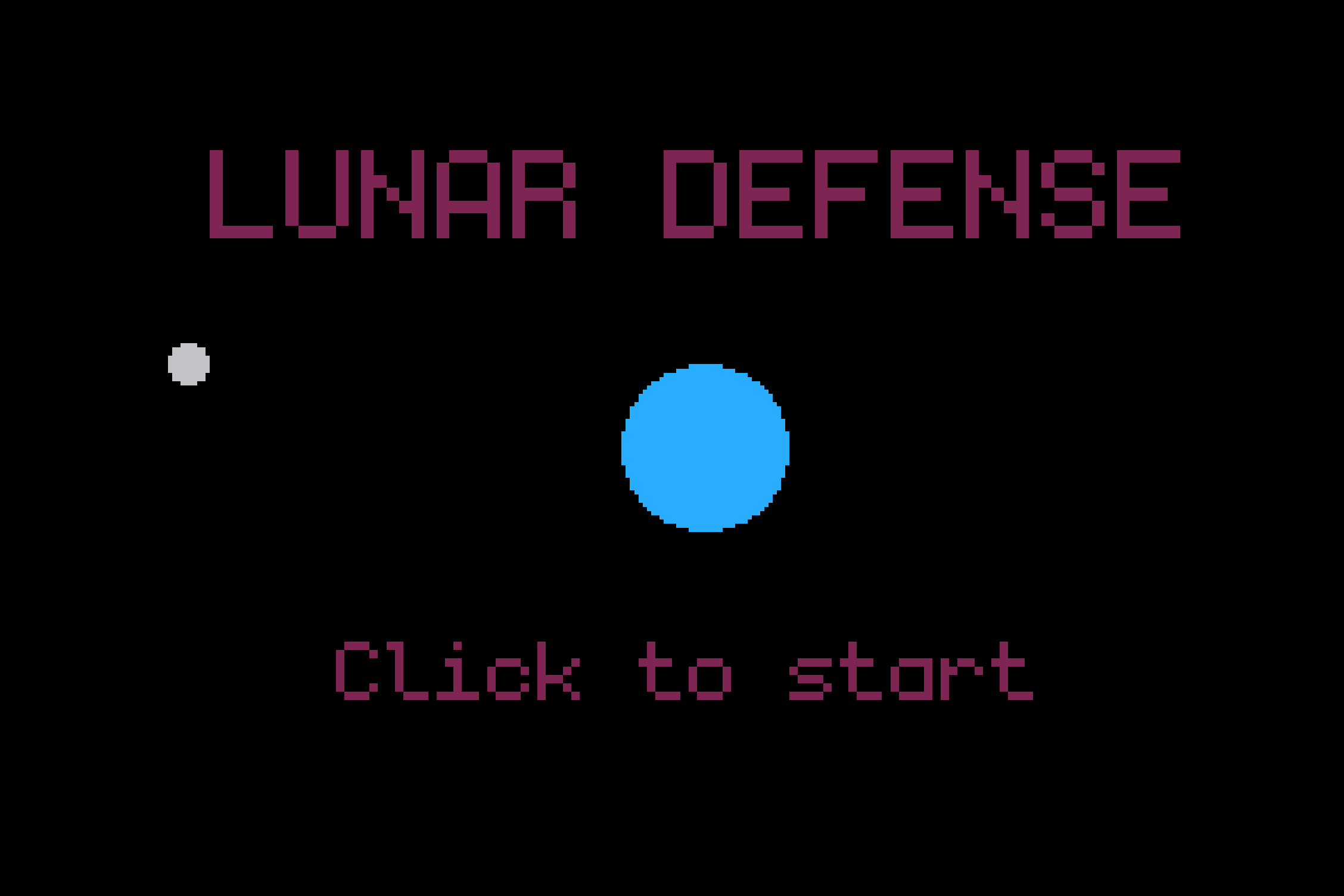
Lunar Defense is a short idle game developed in four hours by mumune. Like most of the jam entries, it can be played right in a desktop browser. Its simple presentation depicts the Earth as a peaceful blue orb in the middle of the screen. Keeping watch over our planet is a smaller grey orb, the Moon, in a wildly eliptical but mercifully stable orbit.
The Moon's job in this game is to protect the Earth by swinging in front of incoming asteroids, which approach from random directions. In keeping with the genre, you have a panel on the right from which you can buy upgrades. At the beginning of the game, you earn one dollar for every asteroid intercepted by the Moon, and lose one dollar each time an asteroid strikes the Earth.
In what I found to be an inspired interface flourish, you can use your mouse wheel to speed up or slow down the Moon in its orbit, in an attempt to better "catch" the asteroids as they approach. That's cool--a very Playdate crank-esque design decision. Your only other means of direct interaction with the game is to purchase upgrades from the right-hand panel.
The opening minutes of the game are a struggle. The Moon is a tiny cosmic speck on a long and ponderous journey, so its chances of intercepting an asteroid, even with fine-tuned speed control, are poor. You make a dollar, the asteroid takes a dollar, then another, and another. You'll spend a little while hovering infuriatingly between zero and one. The first upgrade on the path, which will double your profits to two dollars per interception, stands tantalizingly just out of reach at five dollars.
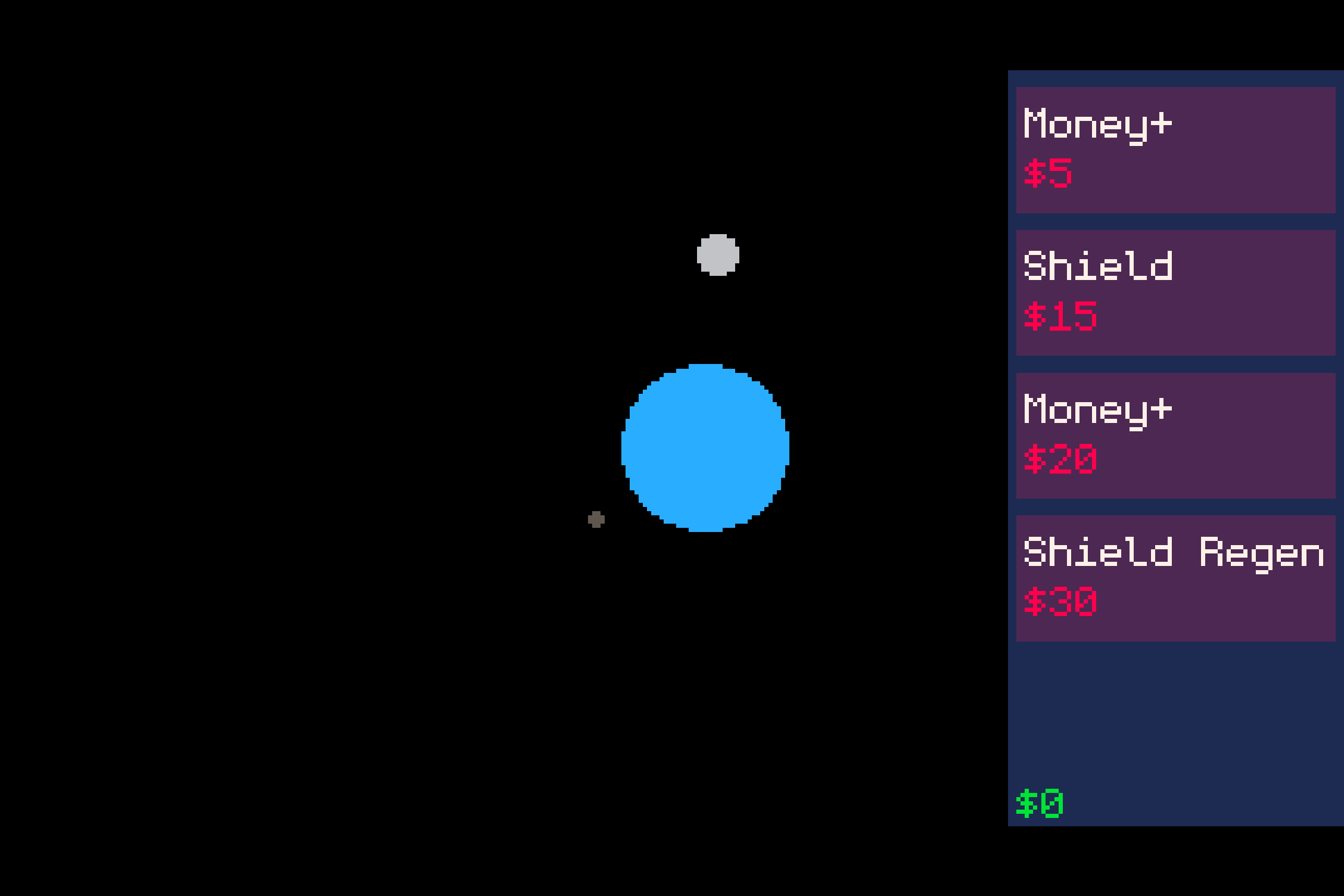
Eventually, after tanking a lot of hits, you'll get there, and the game begins to open up as more upgrades find themselves within your financial grasp. In short order you can have a shield that will absorb one asteroid hit before slowly recharging. You can add maximum hit points to the shield or speed up its regeneration rate. You can further increase your profits-per-interception. Eventually, you can even bring in more Moons to join our familiar solitary companion in its orbit, making your defenses that much more secure.
One upgrade caught my attention, and motivated this article: you can increase the number of asteroids that approach the Earth.
As a function of their design, idle games tend to mostly play themselves--number goes up, and when the number gets big enough, you buy stuff to make the number go up faster. While I liked the idea of the speed control afforded by the mouse wheel, I found in practice that I settled into simply revving the Moon up to its maximum orbital velocity and hoping for the best. Jesus take the Moon, I suppose?
The actual choices presented to the player in this kind of game are likewise limited, and in this case, since I've already discarded speed control, all I am left with is some leeway in the order of upgrades. Even that leeway is limited to the four next upgrades in the list. In such a stripped-down game, I'm inclined to think more deeply about the scant few choices I do have.
As I settled into Lunar Defense's groove, I found myself playing a very, well, defensive game. I skipped ahead in the upgrade list, as much as I was allowed, to grab the shield upgrades first, with the money upgrades as my secondary priority. I avoided the Asteroids+ options for as long as possible. It was only when I was left with four levels of Asteroids+ to choose from, the rest of the list invisible until I took one, that I relented.
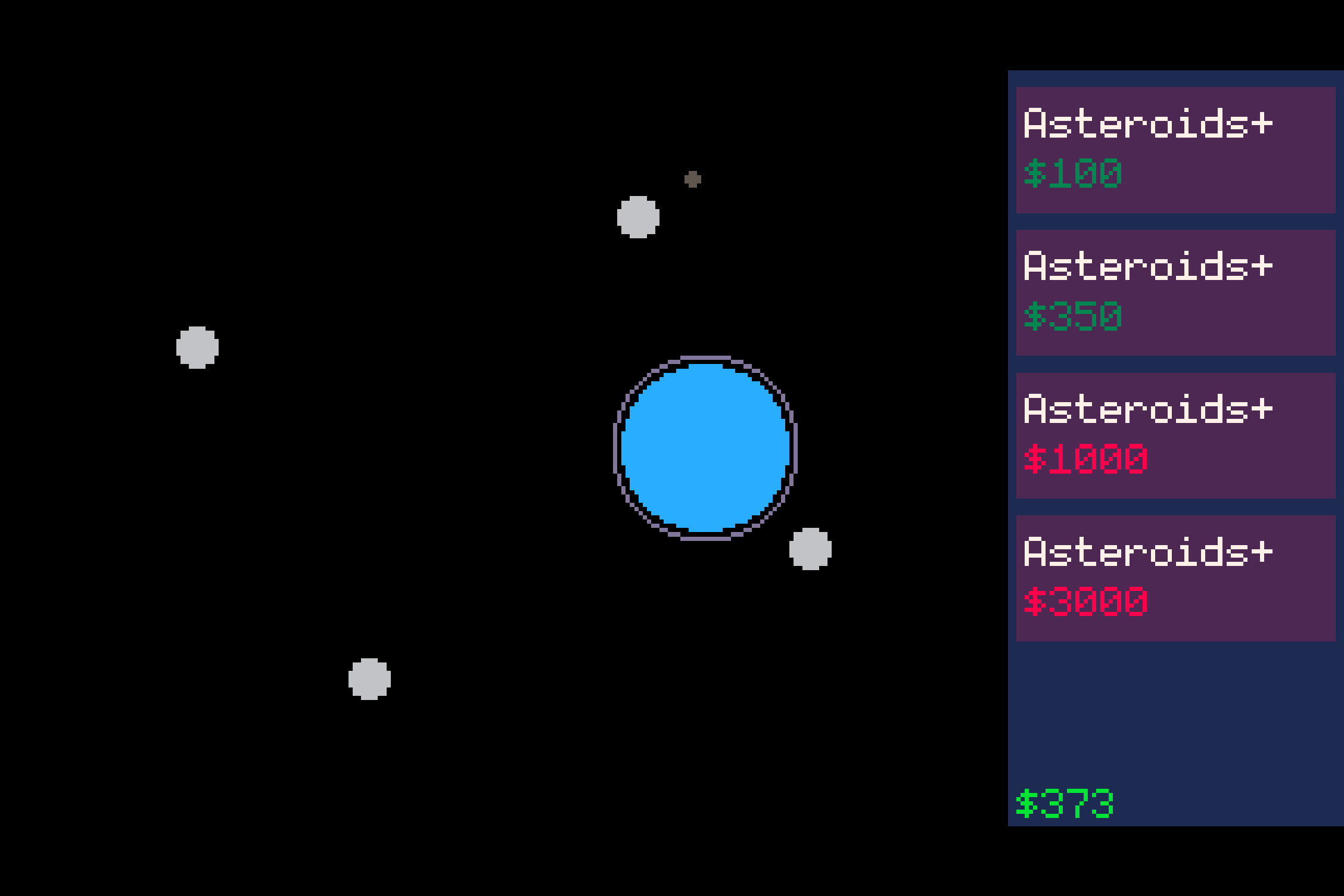
By the time I did, my defenses were quite formidable. I had four Moons wheeling around like the universe's most uncertifiable waveswinger. My shield was several hit points deep, and never took enough whacks to drop entirely. I was also making, by my own subjective standards, plenty of money.
Yet this was not, depending on how you care to approach it, the most "optimal" route. Asteroids in this game are both your only threat and your only source of income. Taking more of them sooner would have brought the money in faster, allowing me to max out the upgrade tree and complete the game sooner. It takes very few upgrades to ensure that your profits will consistently and reliably outpace the costs incurred by impacts. All I would have to do to make the number go up faster--to play more optimally--would be to allow a few more rocks to hit the Earth here and there.
Videogames, like all computer software, are collections of numbers that somebody has arranged to jump through hoops by staring at a screen for hours on end as they pour their lifeblood into figuring out what order those numbers need to go in to work properly. The only numbers Lunar Defense opts to present to the player directly and overtly are financial. You have this much money in the bank. Upgrades cost that much. An asteroid impact incurs this financial blowback.
A real-life asteroid impact, needless to say, would be devastating. Even a modest-sized bolide landing in an unlucky spot could kill thousands or more, and the Tunguska impactor of 1908 completely flattened over two thousand square kilometers of forest.
Lunar Defense, by contrast, is strictly minimalist in its presentation--the Earth a blue circle, the Moon a grey one. There's no graphical flourish or "juice" when an asteroid hits the Earth--no explosion, no puff of smoke, indeed no sound at all. The game doesn't count your misses, doesn't count lives, not yours, not anybody going about their day on the Earth's surface.
It's theoretically possible, if you view the real world through so remote an abstraction, to not count lives here, either. Anything is possible, and justifiable, as long as the profit margins are healthy.
Even so, the Optimal Route for me was never going to be to maximize my profits. Instead, I deviated from the suggested order of the upgrade path. After that early gruelling climb, where the game very successfully made me feel quite helpless, I made it so that no asteroid would ever collide with the Earth's surface again.
Four-hour development time, and mumune got me feeling all of that.