Present in a Space With People
July 25, 2026
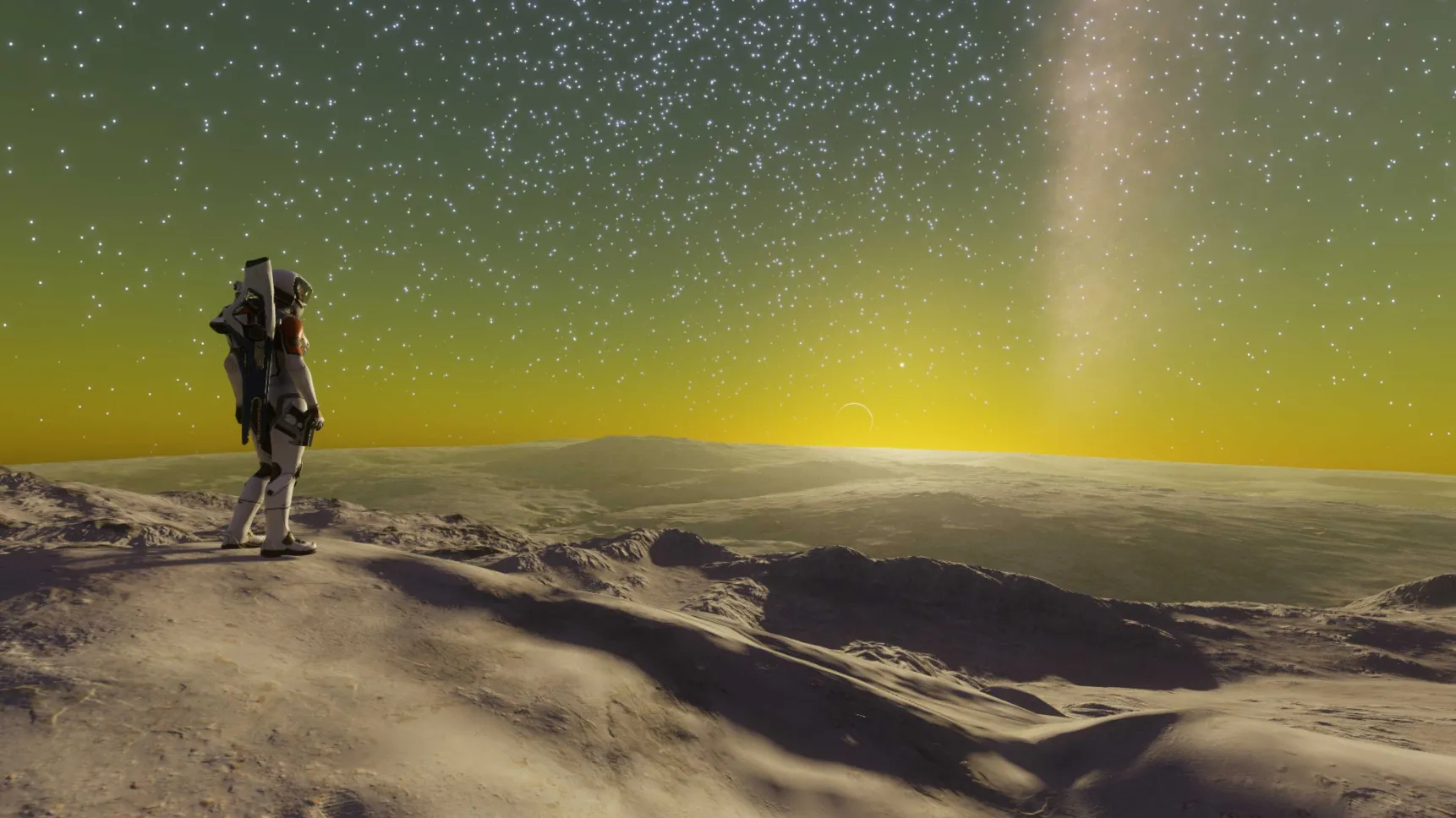
I'm not a very social player. I'm the kind of person who hit the level cap in Phantasy Star Online, offline--first out of necessity, as a child playing burned discs on a secondhand Dreamcast, then much later by choice via the GameCube port that extended the campaign and doubled the level cap, then again via private servers, where technically yes I was connected to the network but never actually played with other people.
There's a pattern here. Local multi is still king but I rank fighting games by their campaigns and single player offerings. My preferred shooters are largely of the boomer persuasion. Mobas and class shooters are almost entirely alien to me. I ran Elden Ring twice with messages turned off and was never troubled by the threat or thrill of a player invasion.
I think it's a pretty uncontroversial thing to observe that the COVID-19 pandemic and its associated lockdowns dramatically altered the shape of gaming for many people. Folks who didn't really fuck with videogames suddenly found themselves seeking refuge in them. Tastes gravitated toward gentler, lower-impact games. People recreated the outlines of their old lives in games that simulated jobs, chores, gatherings, and everyday tasks.
Me, I've never been an Animal Crossing girlie. Couldn't give you a particular reason why. I've tried to get into it a few times and it's never stuck. But my tastes and habits did change over the year and a half when I was stuck inside, alone in a basement apartment.
World of Warcraft is a boat that I fully missed the first time around. It debuted a couple of years before I went to university and really had the online autonomy (and credit card) to lock in. As it soared to the peak of its popularity and cultural saturation with its first few expansions, I was in the back of lecture halls playing roguelikes (remember those?) on a netbook (remember those?).
This is not to say I was never curious about WoW, but anybody who has ever tried to hop on to an online game several expansions deep (waves at Destiny 2) is familiar with the where-to-start problem. Some of these games do a better job of onboarding the newbies than others, but even the best-managed service games accumulate a certain legacy debt over time.
Anyway, the boat didn't swing back around for me until WoW Classic. Could I have had a better version of this experience years earlier with private servers and a little curiosity? Sure. But advertising and convenience make ready bedfellows, and I already had two friends who were weathered vets from the early days of the game, both of them eager and willing to shepherd me through Azeroth. I bit.
Even in its stripped-down, pre-Burning Crusade state, WoW is a game that you can absolutely play like a freak. You can keep a build calculator and a quest tracker tabbed. You can optimize your route through the campaign to just get to the raids. You can join a guild and get yelled at for missing practice like you're on a high school basketball team gunning for regionals.
This wasn't me, but that didn't make me Not Like Other Girls either, because the casual player has always been part of the MMO business strategy, maybe the larger part. Without having to go back and read through my comps list, I was having all of the experiences that Big Deal game studies folks were publishing books about in the aughts. I was logging in just to park my toon in town and chat with my friends. I was hanging out in fields way past the point where I had enough wolf pelts to hand in. I was standing around waiting for the airship and not even mad about it. I was existing in a space, with other people, for its own sake, often in a very goal-agnostic way.
It didn't last. This wasn't because I grew tired of the routine--lord knows some people have kept at it for decades. It was more like a mismatch in playstyles. My friends were oldheads of the join-a-guild-and-get-yelled-at persuasion. They were never short with me, never impatient, but they knew the game. They played more, they progressed faster, I think one of them even rejoined a guild for a bit. I couldn't keep up. I let the subscription run for a few months without logging in and finally cut the cord.
Elite Dangerous was, I'm not ashamed to say, a breakup game. I might be a little more ashamed to say that the whole Xbox One X I put on a credit card to play the game was also a breakup thing, but not by much. You fly a ship through space and the galaxy is persistent and life-sized. It checks boxes I've had since I was a little kid with a shelf full of astronomy books. Might have been retreating to something comforting and familiar on this one.
I think I put something like a thousand hours of lockdown time into Elite--I don't care to go back and check right now because the Xbox is unplugged and I've migrated my account to Steam. It's an always-online game, but in more of an alone-together way than the aughts-era MMO model that incentivized socialization and teamwork. It's a big galaxy, and Elite's a niche game that probably polls highest with Gen-X-ers who played the original on a BBC Micro. Outside of Community Goals and a few high-traffic gank systems, you usually only run into people when you're trying to.
Elite challenges my inbuilt assumptions about hardcore vs. casual play. It has an absolutely fearful grind to it--tame, I think, by space sim standards but an order of magnitude more severe than your typical MMO. It's also a game where you spend most of your time doing very little--plotting a course, jumping from system to system, hauling goods from (Alpha Centauri) A to B, barely touching the stick once you're pointed in the right direction. It's also also a game where parking has a skill curve and traffic violations carry the death penalty.
Elite's an ideal hangout game if you want it to be and you can talk someone into the grind (don't do this). My not-yet-partner, living in another city at the time, bought an Xbox so they could play it on the same platform as me--that one's in storage now too. We spent a lot of evenings just hopping along on hundred-system routes, jumping, recharging, chatting on voice, and only very occasionally crashing into the exclusion zone around a star. Sometimes there's an exotic stellar remnant, or an elaborate ring system, or a mysterious organic cloud to check out. Most of the time there's not. It's a game that thrives in the downtime, where you just exist in a space.
I said way up top that Animal Crossing never took for me, but a few other games on the Switch did. The big one that comes to mind is Clubhouse Games: 51 Worldwide Classics. It's just 51 largely-public-domain games, mostly card, board, and dice games, with a sheen of Nintendo polish and online play. Just before my not-yet-partner moved to that other city at the height of lockdowns, I bought us both a copy. We talked on the phone every night, and sometimes we played Hanafuda. I don't think either of us ever learned the rules of Hanafuda.
If there's a point I'm building to in this account, it's not about the word "friendslop". I'm a millennial in my infirm and elderly thirties and you really should not trust anything I have to say about it. If you're looking for a reasonably sturdy definition, Lotus probably gets closest. The games I'm talking about here don't really check all of those boxes and I'm not interested in writing a hear-me-out to try and squeeze them in.
All I really want to illuminate with this article is that this desire--to be present in a space with people, with just enough "game" around you to provide casual structure and variety--goes all the way back. The first prototype of the first killer app was set up in a bar and required two players. Game consoles came absolutely standard with two controllers in the box until the mid-90s, and most of them were hardwired to the unit until the mid-80s. I bet most of the card, board, and dice games of the world were invented at least in part for the same purpose.
The only things I think are different are that this desire now has a name in popular consciousness, a public who are varying degrees of scarred by having their social world narrowed to the bezels of a screen, and an algorithmic ecosystem living inside those bezels that tilts trends and arguments.
I'm not a very social player, but I think gaming is always a little bit social. I think you can have wikipedic knowledge of Hideo Kojima's Criterion Closet picks and still be a primarily casual player. I think you can cross twenty thousand light years of the galactic medium and measure the time in words rather than hours. I think you can play with Hanafuda cards and never quite learn the rules.