Dangerous
April 29, 2026
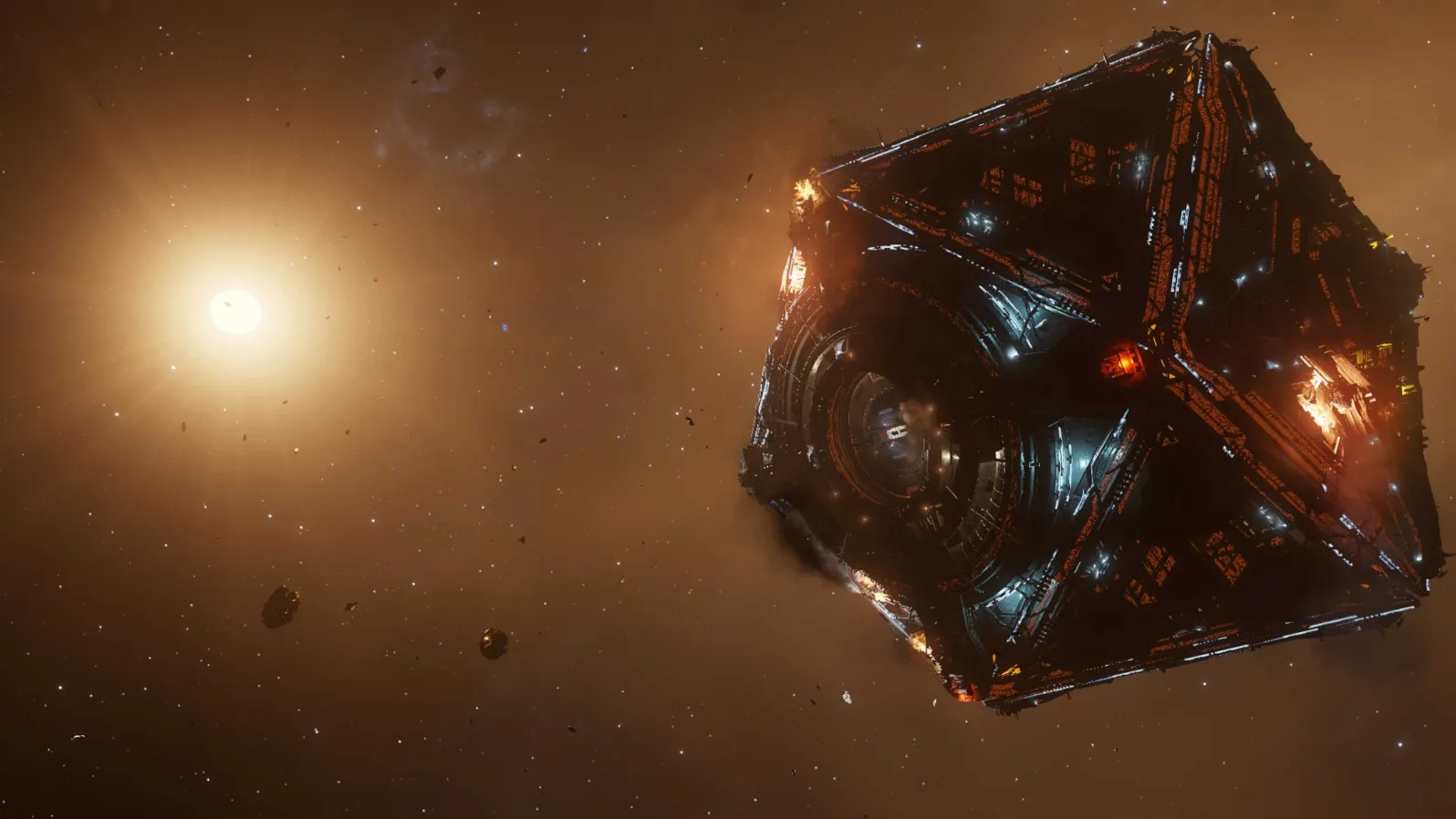
In Elite Dangerous this week, a coordinated pirate attack has severely damaged several orbiting starports throughout Lhou Mans, a heavily-populated independent star system on the periphery of human-settled space. As the crippled starports burn in the vacuum, system authorities have put out a call for independent pilots to participate in a coordinated rescue effort to ferry survivors off of the damaged stations to safety.
In the game's parlance, this is a Community Goal, a limited-time in-game event that players can participate in for rewards. There's some excitement among Elite players given that this kind of gameplay--rescue missions--is making a return after several years of absense. The CG also coincides with the release of a new in-game ship, Zorgon Peterson's hardy and nimble Lynx Highliner, which is purpose-built for this kind of gameplay.
I have made repeated reference to the idea that the setting of Elite Dangerous is kind of a libertarian nightmare, and while the justifications I offer tend to run a little broad, this CG has given me a more specific example of what I mean by that.
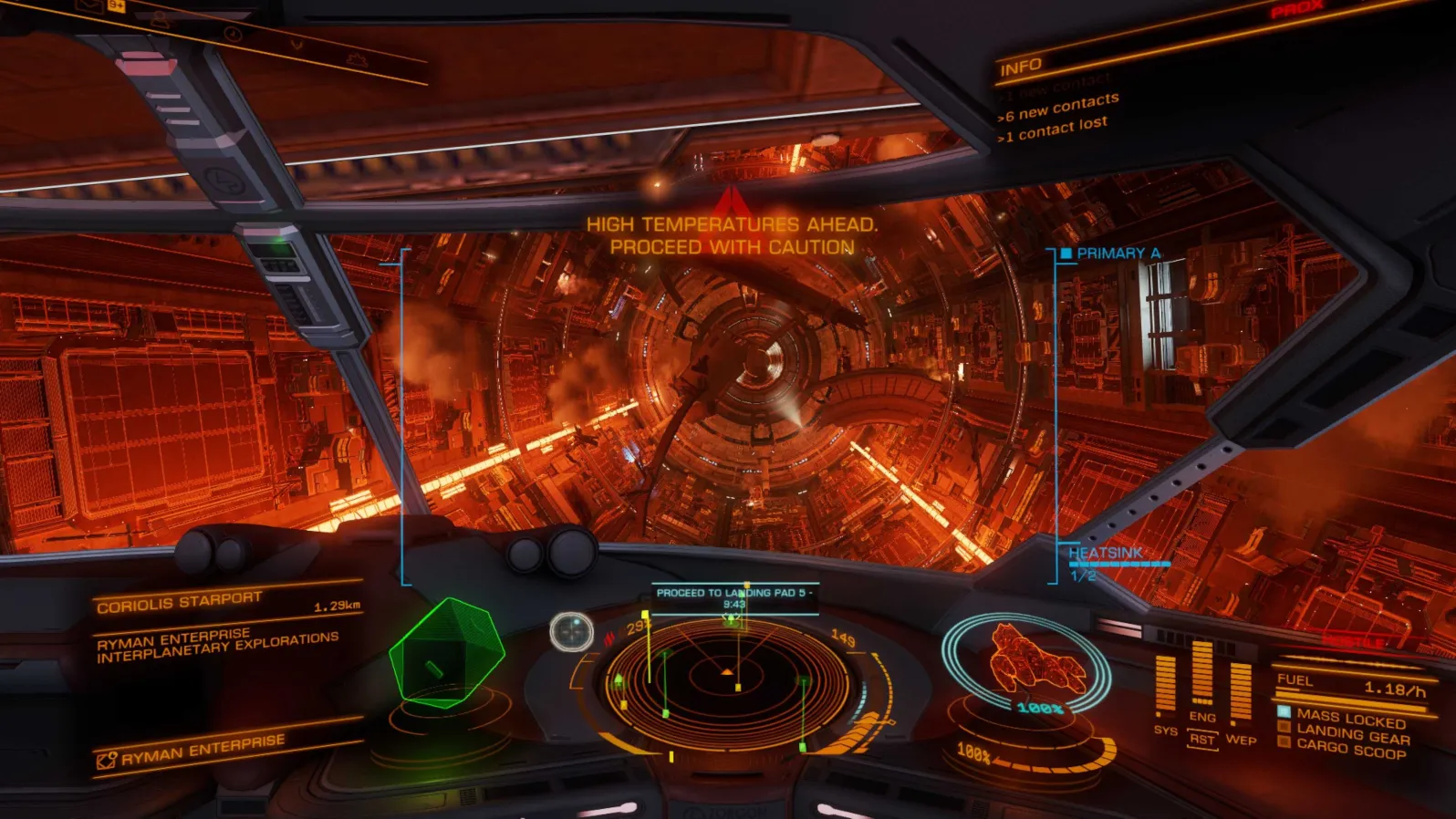
First, I'll describe the actual gameplay. To mount a rescue mission, you need to assemble a vehicle for the job. This means outfitting a ship for high heat resistance (burning stations have very high interior temperatures) and high passenger capacity. You also want a decently-nimble craft, since there are free-floating debris between you and the landing pad.
Entering a damaged station combines the historical acrobatic challenge the series is known for with additional urgency, as you dart into the station and hastily dock with your assigned landing pad while avoiding debris and managing your heat levels. From relative safety belowdecks, you navigate the station's interface terminal to accept passenger missions and ferry surviors onto your ship. Once your passengers are secure, you make a similarly hasty departure and evacuate the survivors to the destination of their choosing. Sometimes that's a conveniently-located rescue megaship in orbit around the same planet as the station, but there isn't one this time and instead the survivors are requesting various ports in nearby systems.
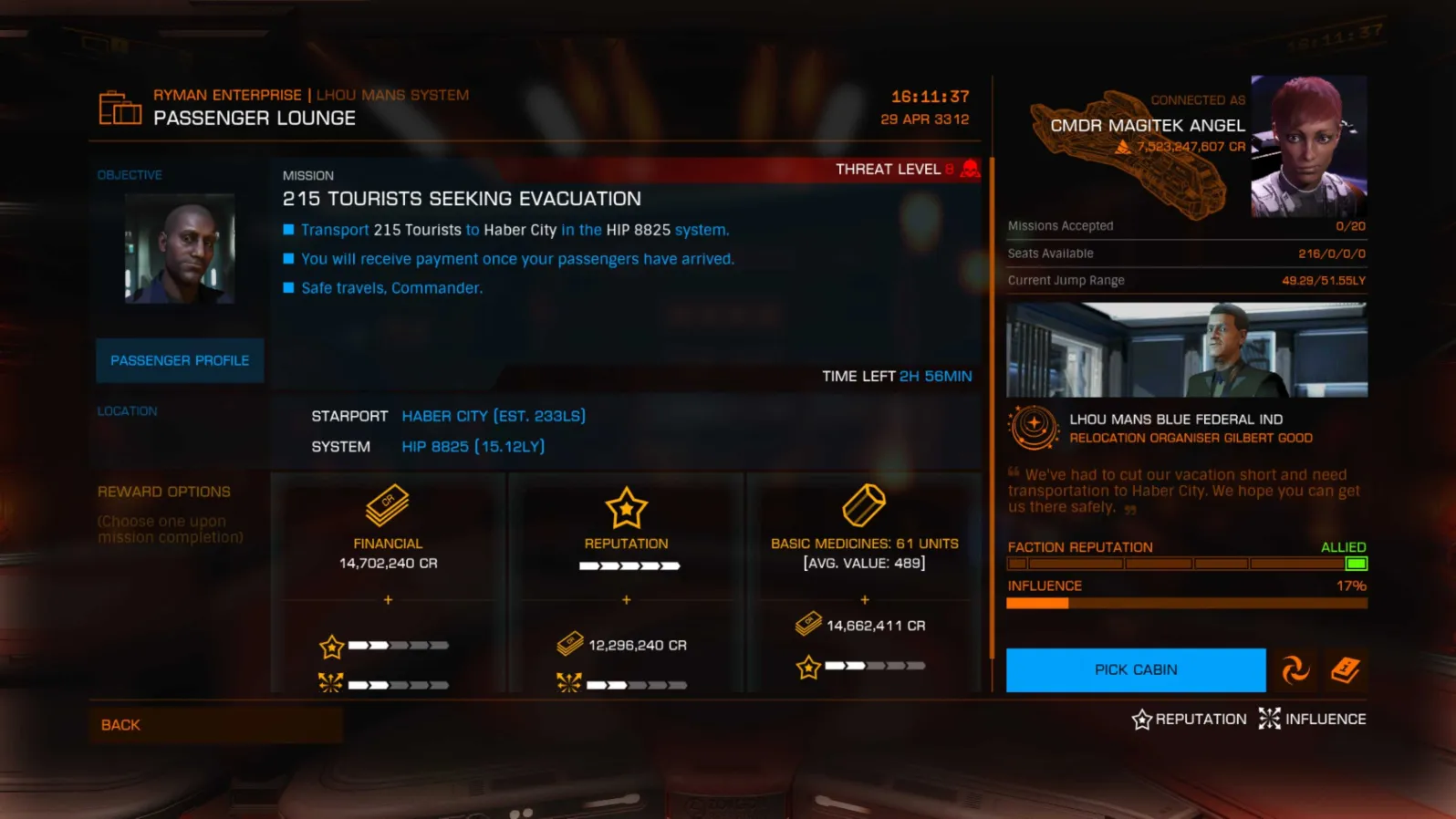
Nothing in the world of Elite Dangerous is free. The station interface terminal shows you up front what rewards you will receive for accepting each group of passengers awaiting evacuation. There is a degree of flexibility in the rewards offered--you always have the option to accept straight cash, but some missions also allow you to forego some credits in favour of valuable cargo or engineering materials, or the more nebulous repuation and influence, which respectively dictate how much a faction trusts you and how much standing they have in relation to other local factions.
Overall, however, the system incentivizes you in a very transparent way to prioritize the survivors that offer the highest payouts. On the first visit, you might see a group offering 6 million credits and bring them on board. Over successive trips, as your reputation grows, you may spot the occasional group offering 30, 40, or even 50 million, and then you'll wonder why you ever settled for six. Noticing the distribution of these rewards, you might even hop back into the garage to swap to lower-capacity business-class cabins, since the wealthier (and higher-paying) survivors will refuse to fly economy, even in a rescue.
Community Goals are mostly cooperative affairs. All players who participate share the same goal--ferry survivors out of danger--and all player contributions to that goal are fed into a common pool of overall progress for the event. CG progress is organized into tiers, which unlock successively higher rewards for participants, and the current Lhou Mans rescue CG has seven tiers of progress.
For this event, progress is not measured by the number of survivors rescued. The only number that matters for the CG is the number of credits earned.
The most striking thing I notice about rescue missions, however, is not the monetary incentive. That's just capitalism working as intended. To bump us up to "libertarian nightmare" demands something extra.
There are no ambulances in Elite Dangerous. There are no fire trucks in Elite Dangerous. There are police, there are private security, there are militaries, and there are warships, but there is no visible civil infrastructure in the game dedicated to helping and caring for people in an emergency. This appears to be out of scope for interplanetary governments in the 34th century. First response is a wholly private and independent enterprise.
I need to be a little cautious here. All videogames are varying degrees of abstraction. Pallet Town is just two houses and Professor Oak's lab, but it's also not really just two houses and a lab. That's just what works within the scope of the abstraction. We are meant, as players, to imagine a larger, richer Kanto, and if we compare Pokemon to a play, the buildings we see are just the stage dressing.
Maybe Elite has ambulances and fire trucks. Maybe there is some kind of civil infrastructure for emergencies, and as players, we just never see any of it because they're beyond the scope of the abstraction. The cops are still there.
When you first drop out of supercruise in front of Ryman Industries, the Coriolis Starport closest to the Lhou Mans primary, it tumbles in silence, venting smoke and flames into the void. When the station's flight operator hails you on comms, you can hear his barely-managed panic. The note of prayer in his voice--that your ship has room to hold warm bodies, that you're here to help people on your own private initiative--never quite reaches the point of outright begging you for help.
But it sure doesn't sound like anybody else is coming.